
How to Build Healthy Habits That Actually Stick — What Behavioral Science Says

Habit formation advice is dominated by two approaches that both fail in consistent ways. The motivation approach tells you to connect your habits to your values, find your why, and visualize your future self. This works until motivation runs out, which it reliably does, because motivation is a feeling rather than a system and feelings fluctuate. The discipline approach tells you to simply do the thing regardless of how you feel, that discipline is a muscle you build, and that successful people just make themselves do things. This works until life creates enough disruption that the discipline narrative becomes “I’ve failed” rather than “I had a difficult month,” at which point the habit is abandoned. What behavioral science actually tells us about habit formation is more specific and more useful than either of these frameworks. How habits actually form — the neurological reality A habit is a behavior that has become automatic through repetition — executed with minimal conscious deliberation in response to a specific cue. The neural pathway for a habituated behavior is more efficient than the pathway for a deliberate one, which is why habits feel effortless and new behaviors feel costly. The formation of this neural pathway requires: a consistent cue that reliably precedes the behavior, the behavior itself executed consistently, and a reward that reinforces the association between the cue and the behavior. This is the habit loop (cue → routine → reward) that James Clear popularized and that underlies most contemporary habit advice. The insight that most advice underutilizes: the cue is more important than the motivation. A behavior that follows reliably from a consistent cue requires much less deliberate motivation than a behavior you’re trying to do “sometime today.” The person who exercises immediately after arriving home from work every day (home arrival is the cue) maintains the habit better than the person who plans to exercise “in the afternoon” because a defined cue produces automatic behavior where an undefined time slot produces a daily decision. Habit stacking — the most practical implementation Habit stacking attaches a new behavior to an existing one, using the existing behavior as the cue. The formula: “After [EXISTING HABIT], I will [NEW HABIT].” After making my morning coffee, I will take my supplements. After getting into bed, I will read for ten minutes. After lunch, I will walk for five minutes. The power of this approach is that it doesn’t require finding new time slots or building new cue systems — it borrows the consistency of existing automatic behaviors to provide the cue for new ones. Most people have five to ten rock-solid existing habits (morning coffee, brushing teeth, eating meals) that can serve as anchor points for new behaviors. Making habits small enough to always do The minimum viable version of a habit maintains the cue-behavior-reward loop even on the worst days, when the full version of the behavior isn’t possible. The minimum viable exercise habit is two minutes of movement, not thirty. The minimum viable reading habit is one page, not one chapter. The minimum viable meditation habit is one breath taken intentionally, not twenty minutes. This sounds trivial and is functionally important. The behavior that happens every day, even in its minimum form, builds a stronger neural pathway than the behavior that happens at full volume inconsistently. The “never miss twice” rule — the practice of doing the minimum version if the full version isn’t possible, ensuring the habit isn’t missed more than once in a row — preserves the cue-behavior association through disruption. Environment design over willpower The environment changes that reduce the friction between deciding to do something and actually doing it produce more consistent behavior than motivation or discipline. The workout clothes laid out the night before remove one friction point from the morning exercise decision. The book on the pillow (rather than the phone) changes the default bedtime behavior. The fruit visible on the counter changes the default snack selection. The meditation app as the first icon on the phone home screen changes the morning decision default. Every friction reduction produces more reliable behavior than an equivalent effort spent on motivation or discipline. The habit that requires minimal decisions to initiate is the habit that survives the days when decision capacity is depleted.
Gym Shoes for Lifting Women — Which Training Shoes Actually Help

Running shoes are terrible for lifting. This is one of those things that seems obvious once you know it and is completely non-obvious before. The thick, cushioned heel of a running shoe compresses under load — which is great for absorbing impact during running and destabilizing during a squat or deadlift because the base you’re pushing from is moving. A stable, flat shoe with minimal heel compression is what lifting actually needs, and the category of training shoes designed specifically for this purpose produces meaningfully better results in the gym than running shoes worn because they’re the only athletic shoes you own. This is the review of the training shoes worth buying if you actually lift. Nike Metcon 9 — the reference standard for cross training The Nike Metcon 9 costs $130-140 and has held its position as the reference cross-training shoe for several years through genuine product quality rather than marketing alone. The heel is reinforced and stable — 4mm drop, firm heel clip — which provides the stable base that squats, deadlifts, and overhead pressing require. The forefoot is flexible enough for the box jumps, rope climbs, and agility movements that CrossFit-style training includes. The Hyperlift heel insert (included) can be added for Olympic lifting movements where a slight heel elevation improves squat mechanics — specifically the ankle dorsiflexion in a clean or snatch. Removable for movements where flat is better, insertable for weightlifting. This versatility across movement types is the Metcon’s primary advantage over dedicated weightlifting shoes. The fit is secure through the midfoot with a locking lace system that prevents foot shift during lateral movements. The upper is durable — this is a shoe that looks presentable after a year of regular gym use rather than looking worn after three months. The honest limitation: the Metcon is not a comfortable walking shoe and is not designed to be. The firm, flat heel that makes it excellent for lifting makes it noticeably less comfortable for extended walking or standing. It’s a gym shoe that stays in the gym bag. Reebok Nano X4 — the alternative with different strengths The Reebok Nano X4 costs $130 and is the cross-training shoe comparison that comes up most often against the Metcon. The Nano has a slightly softer feel — not cushioned in the running shoe sense, but less board-stiff than the Metcon — that some people find more comfortable for longer gym sessions without sacrificing meaningful stability. The Flexweave upper construction on the Nano is more breathable than the Metcon’s upper and the shoe runs slightly wider in the toe box, which matters for people with wider feet who find the Metcon uncomfortably narrow through the front of the foot. For pure weightlifting — squat-focused training, powerlifting, strength-specific programming — the Metcon’s firmer heel provides a marginally better platform. For mixed training where the gym session involves both lifting and conditioning, the Nano’s comfort advantage over longer sessions is relevant. NoBull Trainer — for the aesthetic-conscious lifter The NoBull Trainer costs $129-149 and occupies the premium aesthetic position in the cross-training category. The SuperFabric upper is durable, the design is deliberately minimal, and the shoe has built a following in the CrossFit community that extends beyond functional merit into identity territory. The performance is genuinely good — the heel is stable, the forefoot is flexible, and the shoe handles most cross-training applications well. The performance difference between NoBull and the Metcon or Nano is smaller than the brand positioning suggests. What NoBull offers that the others don’t is the specific aesthetic — the clean, design-forward look that photographs well and has become a signal within certain fitness communities. For someone who values the aesthetic alongside the performance and is comfortable at the slightly higher price: NoBull is a legitimate choice. For someone who primarily cares about performance: the Metcon or Nano at similar or lower prices are the better purchases. For dedicated weightlifting — Adidas Adipower 3 If your training is primarily Olympic weightlifting or powerlifting squat-focused and you want a dedicated weightlifting shoe rather than a cross-trainer, the Adidas Adipower 3 ($200-220) is the shoe worth knowing. The 15mm wooden heel raise creates the ankle angle that most people’s mobility doesn’t allow flat, making deep squat positions more accessible. The fully rigid construction provides a stable base that no cross-trainer fully replicates. The trade-off is obvious: this shoe does one job exceptionally well and is unsuitable for any other purpose. It’s a gym-bag shoe for training sessions that are primarily squat and Olympic lift focused. What to look for in a gym training shoe Heel drop of 4mm or less. Running shoes typically have 8-12mm drop, which creates instability under load. Training shoes at 4mm or less keep you closer to flat, which is what the lifts need. Firm, non-compressible heel. Press your thumb firmly into the heel of any shoe you’re considering for lifting. If it compresses significantly, that compression happens under barbell load too. A heel that doesn’t move under thumb pressure will provide a stable platform under weight. Secure midfoot lockdown. Foot shift during lateral movements or heavy lifts produces instability that affects both performance and safety. The lacing system and midfoot construction should hold the foot firmly in place.
Best Home Gym Equipment — What’s Actually Worth Buying
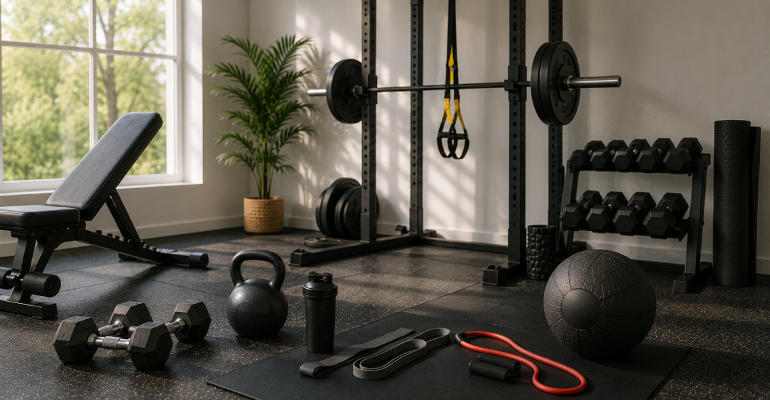
Home gym equipment marketing is dominated by products that look impressive, photograph well, and produce limited return on investment for the space and money they require. The elaborate cable machine. The full rack of fixed-weight dumbbells. The commercial-grade cardio equipment that becomes a very expensive clothes hanger after month two. The home gym that gets used is the one built around the minimum effective equipment for the specific training goals of the person who owns it. Not the aspirational equipment for the training they imagine doing — the equipment for what they’ll actually do. Adjustable dumbbells — the single highest-value home gym investment A pair of adjustable dumbbells replaces a full rack of fixed-weight dumbbells at a fraction of the space and cost. For most home training scenarios — strength training, hypertrophy, conditioning circuits — adjustable dumbbells cover the majority of exercises. The Bowflex SelectTech 552 ($350-400 for a pair, 5-52.5lbs per dumbbell in 2.5lb increments) is the most consistently recommended option. The dial-adjust mechanism is reliable, the adjustment takes seconds, and the weight range covers most home training needs. The Ironmaster Quick-Lock ($400-500 per pair) is the alternative for people who want a more traditional feel — the weight plates are actual iron rather than the plastic-enclosed system of the Bowflex — and higher maximum weight (75lbs per dumbbell in the basic set, extendable to 120lbs). The adjustment takes slightly longer than the Bowflex. The PowerBlock Elite ($300-400) is the third option — a compact, stacked design that’s the most space-efficient of the three and the one most commonly seen in professional training environments. The selectorized mechanism is fast and reliable. Resistance bands — underrated for the space and cost A set of resistance bands ($20-50 for a quality set) provides more exercise variety for their size and cost than any other category of home gym equipment. Hip hinges, upper back exercises, mobility work, rehabilitation exercises, and assistance for bodyweight movements (band-assisted pull-ups, for example) — resistance bands serve as exercise tools, mobility aids, and warming-up equipment that dumbbells alone don’t cover. The specific sets worth buying include a hip circle (hip abduction work, warm-up for squat patterns), a set of loop bands in multiple resistances (mobility, warm-up, rehabilitation), and a set of tube bands with handles (resistance in directions that dumbbells don’t provide). Total cost for all three categories: under $80 for quality versions of each. A pull-up bar — if your space allows A doorframe pull-up bar ($30-50) provides resistance for the horizontal pulling movement pattern that dumbbells and bands address less completely. Pull-ups and chin-ups are among the most effective upper body exercises available and are poorly replicated without any equipment that provides overhead resistance. The doorframe mounted versions (Iron Gym, Perfect Fitness) work for most standard doorframes. For people willing to drill into a wall, a wall-mounted pull-up bar produces more stability and more exercise options. What’s not worth buying for a home gym A rowing machine, assault bike, or ski erg unless cardiovascular training is the specific goal and you’re committed to using it consistently. These are excellent conditioning tools that require dedicated space and deteriorate quickly if unused. A barbell and plates unless you’re specifically training barbell movements and have adequate space and safety equipment. A barbell without a rack produces limited exercise options. A barbell with a rack produces more options but requires a dedicated training space. Any machine that’s specifically designed to be impressive rather than effective. The elaborate cable machine, the chest press machine, the leg press — home versions of gym machines are almost always less effective than they appear because the gym version’s quality doesn’t scale down to the price point of home equipment.
How to Reduce Stress — What the Evidence Actually Says

Stress management advice has a wellness industry problem: most of it is presented in a way that either medicalizes normal human experience or sells products and services as solutions to problems that are more structural than individual. The person with a genuinely stressful job, genuinely unmanageable responsibilities, or genuinely difficult life circumstances doesn’t have a stress management deficit — they have a life circumstances problem that stress management techniques can support but not solve. This distinction matters because it determines which advice is realistic and which sets you up for feeling inadequate when it doesn’t make the underlying situation better. What stress actually is — the physiology The stress response is a physiological system that evolved to deal with acute physical threats. Adrenaline and cortisol are released, heart rate and blood pressure increase, digestion is depressed, the immune system is temporarily suppressed, and energy is redirected to muscles for fight or flight. This system works excellently for its intended purpose — dealing with an immediate physical threat — and is poorly suited to the chronic psychological stressors of modern life, which don’t resolve in minutes the way physical threats do. The stress response is a physiological system that evolved to deal with acute physical threats. Adrenaline and cortisol are released, heart rate and blood pressure increase, digestion is depressed, the immune system is temporarily suppressed, and energy is redirected to muscles for fight or flight. This system works excellently for its intended purpose — dealing with an immediate physical threat — and is poorly suited to the chronic psychological stressors of modern life, which don’t resolve in minutes the way physical threats do. Exercise — the most evidence-supported stress intervention Aerobic exercise produces acute cortisol reduction and has long-term effects on stress system reactivity through several mechanisms including neuroplasticity in regions that regulate the stress response, endorphin and endocannabinoid release, and improved sleep quality which independently reduces stress system reactivity. The dose doesn’t need to be large for stress effects: thirty minutes of moderate-intensity exercise (brisk walking counts) three to five times per week produces measurable effects on stress and anxiety in controlled studies. The exercise doesn’t need to be high-intensity — there’s evidence that high-intensity exercise, while producing more fitness adaptations, also activates the stress response itself and may be less beneficial for stress management than moderate intensity for some people. Controlled breathing — the fastest acute stress intervention The physiological stress response is activated by the sympathetic nervous system and calmed by the parasympathetic nervous system. The only voluntary control most people have over this system is through breathing — specifically, extending the exhale relative to the inhale activates the parasympathetic response and produces measurable heart rate reduction and calm within minutes. The 4-7-8 breathing pattern (inhale for 4 counts, hold for 7 counts, exhale for 8 counts) is the most frequently cited version. The box breathing used by Navy SEALs (4 counts in, 4 hold, 4 out, 4 hold) is the most widely studied. The specific pattern matters less than the general principle: a longer exhale than inhale activates the parasympathetic response. This technique requires no equipment, no subscription, no time commitment beyond a few minutes, and produces a genuinely rapid physiological effect on stress activation. It’s the highest-ROI intervention in the category. Social connection — the variable most stressed people neglect Sustained social connection is one of the most robust protective factors against both acute and chronic stress in the longitudinal research. The stress-buffering effect of social support — having people to talk to about stress rather than carrying it alone — reduces both subjective stress experience and physiological stress markers. Loneliness amplifies the physiological stress response and activates the same neural pathways as physical pain. Social isolation during high-stress periods produces worse outcomes than the stress alone. This matters because high stress periods are the times when social maintenance tends to be deprioritized — when you feel too busy and overwhelmed to maintain relationships. The minimum viable social connection that produces the stress-buffering effect is less intensive than people assume: regular contact with a few meaningful relationships, not a large social network. Quality and frequency matter more than breadth.
Skincare Routine for Beginners — What You Actually Need

The skincare industry would prefer you believe that healthy skin requires twelve steps, multiple serums, monthly facials, and a rotating cast of active ingredients carefully scheduled to avoid conflicting with each other. The market for complexity is large and the rewards for manufacturers who create it are significant. The reality of what most people’s skin actually needs is considerably simpler. A four-step routine executed consistently produces better results than a twelve-step routine followed inconsistently. The right four steps, which don’t need to be expensive, are what this guide is about. Step one — cleanser A cleanser removes what’s on the skin surface: sunscreen, makeup, pollution, excess oil, and the day’s accumulated material. The goal is a clean skin surface without disrupting the skin’s natural barrier. The most common cleansing mistake is using a cleanser that’s too harsh for the skin type. A cleanser that leaves skin feeling “squeaky clean” has removed not just the surface material but a portion of the skin’s natural lipid barrier, which leads to the skin overproducing oil in compensation and creating the dryness-and-oil cycle that many people attribute to their skin type rather than their cleansing habits. The correct cleanser for most skin types: a gentle, low-pH cleanser without soap (which is too alkaline for skin). CeraVe Hydrating Cleanser (for dry to normal skin), La Roche-Posay Toleriane Purifying Foaming Cleanser (for oily to normal skin), and Cetaphil Gentle Skin Cleanser are the three most consistently recommended accessible options. None of them are expensive. All of them are effective. Step two — moisturiser Moisturiser maintains the skin’s hydration and barrier function. Even oily skin benefits from moisturiser — the belief that oily skin doesn’t need moisturiser is responsible for many people with oily skin making it oilier through dehydration. The ingredients worth looking for: ceramides (restore and maintain the skin barrier), hyaluronic acid (draws moisture from the environment into the skin), and niacinamide (reduces inflammation, regulates oil production, improves skin tone). CeraVe Moisturising Cream contains all three of these at an accessible price and is the most frequently recommended moisturiser in dermatology practices. For daytime, a lighter moisturiser. For nighttime, a richer one. This distinction produces better results than using the same product at both times because nighttime is when the skin does most of its repair and a richer product supports this more effectively. Step three — SPF (morning only) Sunscreen is the single most evidence-supported skincare product available. UV radiation is the primary cause of skin aging, hyperpigmentation, and skin cancer. No combination of serums, antioxidants, or retinoids produces the skin health benefits of consistent daily sunscreen use because they’re addressing the effects of sun damage rather than preventing the damage itself. SPF 30 applied every morning to face and neck is the minimum. SPF 50 for anyone with concerns about photoaging, hyperpigmentation, or those with fair skin. The best sunscreen is the one you’ll actually use daily — the texture and finish matter because they determine whether you like wearing it. The Altruist Sunscreen SPF50 (around £2, one of the highest-SPF products recommended by dermatologists) and the Paula’s Choice DEFENSE Essential Glow Moisturizer SPF30 are examples across very different price points that both work. What comes before — the optional additions A targeted serum between cleansing and moisturising addresses specific skin concerns that the core routine doesn’t. Vitamin C in the morning (brightening, antioxidant protection, supports collagen synthesis). Retinol in the evening (accelerates cell turnover, reduces fine lines, improves texture). Niacinamide at any time (anti-inflammatory, pore-minimizing, tone-evening). These additions are genuinely useful for the concerns they address and are not necessary for people without those specific concerns. A cleanser, moisturiser, and SPF — executed consistently — produces good skin for the majority of people without additional steps.
Types of Therapy Explained — Which One Might Be Right for You

Mental health treatment has a navigation problem. For someone deciding to seek therapy for the first time, the options are bewildering: CBT, psychodynamic, DBT, EMDR, ACT, person-centered, somatic, and dozens of other approaches each with their own proponents and their own evidence base. The average person seeking therapy has no particular reason to know what any of these mean or which is most likely to help with their specific situation. Most people default to whatever therapist is available or affordable without understanding whether that therapist’s approach is well-matched to what they’re experiencing. This matters because the approach is a meaningful variable in outcome. CBT — Cognitive Behavioural Therapy CBT is the most extensively researched therapeutic approach and the one with the strongest evidence base for the widest range of conditions. It’s based on the relationship between thoughts, feelings, and behaviours — specifically the premise that patterns of thinking affect emotional experience and behaviour, and that changing thought patterns produces changes in both. Practically, CBT is structured, typically time-limited (12-20 sessions is a common format), and involves homework between sessions. You learn specific techniques — thought records, behavioural experiments, exposure hierarchies for anxiety — and practice applying them to your specific situation between sessions. The skills are transferable: what you learn in CBT can be applied independently after therapy ends. CBT is well-supported for: anxiety disorders (generalised anxiety, social anxiety, panic disorder), depression, OCD, PTSD, eating disorders, and various other conditions. It’s the approach NICE (the UK’s health guidelines body) recommends as first-line treatment for most of these. The limitation: CBT is less well-suited for people whose primary concern is understanding their patterns, processing childhood experiences, or exploring their sense of self rather than symptom reduction. It’s a skills-focused, forward-looking approach that doesn’t go extensively into historical causes. Psychodynamic therapy Psychodynamic therapy comes from the psychoanalytic tradition and focuses on how unconscious processes, early relationships, and past experiences shape current behaviour and emotional experience. Rather than teaching specific skills, it explores patterns in how you relate to yourself and others, what defences you’ve developed, and what early experiences might be contributing to current difficulties. It’s typically longer-term and less structured than CBT, which is either a limitation or a feature depending on what you need. For people who want to understand themselves more deeply rather than primarily to reduce specific symptoms, and for people whose difficulties feel relational and historical rather than skill-based, psychodynamic approaches often produce insights that CBT doesn’t reach. The evidence base is less extensive than CBT’s but growing, particularly for longer-term outcomes and for personality-related difficulties. EMDR — for trauma specifically Eye Movement Desensitization and Reprocessing is an approach specifically designed for trauma and PTSD. The protocol involves briefly and repeatedly activating traumatic memories while simultaneously engaging in bilateral stimulation (typically eye movements following the therapist’s hand, though tapping and sounds are also used). This bilateral stimulation is believed to engage the brain’s natural information processing in a way that reduces the emotional charge of traumatic memories. EMDR has strong evidence for PTSD specifically and for single-incident trauma. It works faster than many other approaches for trauma — significant progress in fewer sessions — and is now recommended alongside CBT as a first-line treatment for PTSD in most international clinical guidelines. DBT — for emotional regulation specifically Dialectical Behaviour Therapy was developed specifically for Borderline Personality Disorder and is now widely used for any presentation where emotional dysregulation is the central difficulty. The core concepts are dialectical — holding two seemingly opposite truths simultaneously, particularly acceptance and change — alongside specific skills in mindfulness, distress tolerance, emotion regulation, and interpersonal effectiveness. DBT is more intensive than CBT in its standard form: weekly individual therapy plus weekly skills group is the full DBT model. The skill-building component is highly practical and the skills are genuinely useful for anyone with intense emotional experiences, not only those with BPD. How to find the right approach for your situation Anxiety, panic, phobias, OCD: CBT as first choice. PTSD, trauma history: EMDR alongside CBT. Emotional dysregulation, intense interpersonal difficulties: DBT. Wanting to understand yourself more deeply rather than reduce specific symptoms: psychodynamic. General life difficulties, relational issues, or wanting a supportive relationship as the primary mechanism: person-centred therapy. The therapeutic relationship — how well you connect with the specific therapist, whether you feel understood and safe — matters as much or more than the approach. A good therapist in an imperfect approach outperforms a poor therapist in the optimal approach. Don’t stay with a therapist you don’t connect with out of commitment to the relationship.
How to Eat Healthier Without Going on a Diet

The diet industry has produced a specific and measurable outcome over the decades of its existence: most people who go on diets return to their pre-diet weight within two to five years, and a significant proportion gain more weight than they lost. The evidence on this is consistent across different diet types and populations. Diets, as a primary intervention for long-term healthy eating, don’t work for the majority of people who try them. This is not because people lack willpower or commitment. It’s because restriction-based approaches trigger physiological and psychological responses that work against the goal they’re designed to achieve. The body responds to caloric restriction with increased hunger and reduced metabolic rate. The psychology responds to forbidden foods with increased desire for them and guilt around consumption that produces the restrict-overeat cycle. The approach that produces lasting change in how people eat operates differently: it adds rather than restricts, changes environment rather than relying on willpower, and focuses on patterns rather than individual food choices. The addition approach — what it actually means Adding nutritious foods to existing eating patterns rather than removing less nutritious ones is the approach with more consistent evidence for lasting change. The mechanism: over time, nutritious foods that become regular fixtures displace less nutritious foods without the psychological cost of restriction. Adding a portion of vegetables to every meal — not instead of anything, in addition to the existing meal — gradually shifts the proportion of the overall diet toward vegetables without producing the restriction response. The person who eats vegetables at every meal is eventually eating more vegetables than someone who doesn’t, not because they restricted anything but because they added something. Adding protein to breakfast specifically stabilizes blood glucose through the morning in a way that reduces the mid-morning energy crash and accompanying desire for high-sugar snacks. Greek yogurt, eggs, protein smoothies, or any adequate protein source at breakfast is the single dietary change with the most reliable evidence for reducing overall caloric intake through the day without conscious restriction. Environment design — where most change actually happens The most reliable predictor of what someone eats is what’s available in their immediate environment without additional effort. Fruit on the counter gets eaten. Healthy snacks at eye level in the fridge get eaten. Food requiring preparation or specific decisions doesn’t get eaten when time, energy, or willpower is depleted. The three environmental changes with the most evidence behind them: Make nutritious food the path of least resistance. The pre-washed salad. The cut vegetables already in containers. The fruit on the counter rather than in a drawer. The nuts in a bowl rather than in a bag in a cabinet. These changes reduce the friction between wanting to eat something healthy and actually eating it. Remove visible temptation for foods you overconsume. This is not about restriction — the food can still be purchased and eaten. It’s about friction. Food stored out of sight, in a less convenient location, is consumed less without conscious restriction because the impulse to eat it has to overcome the additional step of retrieving it. Portion the food that tends to be eaten in quantities beyond intention. Snack-sized portions of cheese, nuts, crackers, or whatever the specific food is, divided before storage rather than eaten directly from the original packaging, change the serving size through environmental design rather than conscious restraint. The practical protein focus that changes everything Protein is the macronutrient that produces the most satiety per calorie, supports muscle maintenance during weight change, and requires the most energy to digest (the thermic effect of protein is significantly higher than for carbohydrates or fat). For most people eating typical Western diets, increasing protein intake is the single dietary change that most consistently produces improvement in energy, satiety, and body composition without requiring calorie counting. The practical target: 1.6g of protein per kilogram of body weight per day is a reasonable starting target for most adults. For a 70kg adult, this is 112g of protein — an amount that requires some dietary attention to reach but that’s achievable without supplementation through foods like eggs, Greek yogurt, legumes, fish, chicken, and cottage cheese. Tracking protein intake for two weeks (MyFitnessPal or Cronometer make this relatively simple) produces accurate knowledge of your current baseline and a concrete understanding of where the gaps are. Most people who do this find they’re consuming significantly less protein than they thought.
Best Meditation Apps — Honest Review After Using Them

The meditation app market has a specific challenge: the people most likely to subscribe and pay for a meditation app are the people already motivated to meditate, and the people who most need support building a meditation practice are the people least likely to maintain the subscription past the free trial. This is a business model problem that produces apps optimized for people who already know what they want rather than apps that teach people who don’t. The distinctions between the major apps are more specific than “which one is best” and depend on what specifically you want from a meditation practice. Headspace — the best for beginners Headspace costs $70/year and is the recommendation for people starting a meditation practice from nothing. The structured courses — beginning with Basics 1, then Basics 2 and 3, then the larger content library — build skills progressively rather than dropping users into an overwhelming library of unsequenced content. The Andy Puddicombe narration style (Headspace’s co-founder, who trained as a Buddhist monk before building the app) is accessible without being patronizing and clear without being clinical. The animations that accompany much of the beginner content communicate meditation concepts visually in a way that text-based instruction doesn’t. The Sleep content is the second most useful feature: sleep meditations, wind-down exercises, and sleep sounds that help with the racing mind at bedtime. These are among the most commonly used features across the app and among the most consistently reviewed as helpful. The limitation: the content library, while large, is less intellectually substantive than some alternatives. Headspace teaches meditation as a wellness practice; it doesn’t go deeply into the philosophical or psychological theory behind the techniques. Waking Up — for people who want more than stress reduction Waking Up costs $100/year and is the recommendation for people who want to understand what meditation is and why it works, not just follow instructions. Sam Harris (the app’s creator, a neuroscientist and philosopher with a long meditation practice) teaches theory alongside technique — the neuroscience of attention and awareness, the philosophical context of contemplative practice, the specific mechanisms by which meditation changes subjective experience. The daily meditations are genuinely varied — different techniques, different teachers, different approaches — rather than a single consistent methodology. For people who find one-size-fits-all meditation approaches frustrating, the variety produces more engagement. The Waking Up introductory course is the starting point worth taking before anything else in the app — it covers the fundamentals clearly and provides enough context to make the rest of the content meaningful. Insight Timer — the free alternative for experienced practitioners Insight Timer is free for the vast majority of its content and contains thousands of guided meditations from teachers at all experience levels in multiple traditions. The quality is inconsistent — free submissions from any teacher mean significant variation in production quality and teaching quality — but the range is unmatched and the community features (groups, challenges, connection with other meditators) produce engagement that solo practice doesn’t. For someone who already knows how to meditate and wants access to a wide range of styles and teachers, Insight Timer is the obvious choice. For someone new to meditation who needs structured progression, the quality inconsistency makes it less reliable as a starting point. Calm — for sleep and stress specifically Calm costs $70/year and is the recommendation for people whose primary interest is sleep and stress reduction rather than building a meditation practice specifically. The Sleep Stories — celebrity narrators reading atmospheric, intentionally soporific content — are genuinely effective as sleep aids and are the feature that distinguishes Calm most clearly from its competitors. The mindfulness content is good but less pedagogically structured than Headspace. Calm is the app that most clearly positions meditation as a wellness practice rather than a skill being built.
How to Start Exercising When You Genuinely Hate It

Exercise advice is almost exclusively written by people who like exercise, for people who like exercise, or for people who used to like exercise and have lost their motivation. It assumes a baseline enthusiasm that the reader just needs to rekindle. “Find your why.” “Start with something you enjoy.” “Remember how good you feel after.” This advice is useless for a specific and large portion of the population: people who have never particularly liked exercise, who don’t feel particularly good after it, and whose “why” isn’t motivating enough to overcome the genuine discomfort of doing something they’d rather not do. If this is you, this is for you. The wrong goal that makes starting harder Most beginner exercise advice centers on outcomes — lose weight, improve fitness, reduce risk of disease. These are real and worthwhile outcomes with real evidence behind them. They are also terrible motivators for getting to the gym on a cold Tuesday evening when you’re tired and would significantly rather not. The outcome is too far from the behavior to motivate it. The mental math of “this thirty-minute walk will marginally reduce my cardiovascular disease risk over the next twenty years” doesn’t overcome present-moment tiredness and reluctance. This is not a failure of motivation — it’s how human motivation works. We’re better at responding to immediate costs and benefits than distant ones. The goal worth setting instead: find a form of movement that doesn’t make you actively miserable, and do it consistently enough that it becomes habit. Not enjoyable necessarily — not miserable. The enjoyment, or at minimum the reduced aversion, comes later for most people and cannot be front-loaded. The specific question that changes what you try The standard “what exercise do you enjoy” question fails for people who don’t enjoy exercise because the honest answer is nothing. The more useful question: what physical activity is the least unpleasant for you? For some people this is walking — not walking for fitness, just walking, which happens to be genuinely effective exercise and genuinely accessible in a way that most other forms of exercise aren’t. For some people it’s swimming, where the environment is enjoyable even when the effort isn’t. For some people it’s a class format where the social pressure to keep going and the fixed end-time removes the decision-making that derails solo exercise. For some people it’s activity that’s accidentally exercise — cycling as transport, dancing, a sport played for reasons other than fitness. The form doesn’t matter as much as the consistency, and consistency is dramatically more likely with something that’s least unpleasant than with something that requires conquering genuine aversion. The minimum viable starting point The gym routine, the training program, the five-day-per-week schedule — these are goals for later, not starting points. The starting point for someone who doesn’t exercise and doesn’t enjoy it is smaller than any structured program suggests. Twenty minutes of walking per day is a legitimate starting exercise program for a sedentary adult. It’s not optimal by the standards of exercise physiology. It’s achievable, it produces real benefits, and it builds the behavioral pattern of regular movement before the volume and intensity are addressed. The person who walks for twenty minutes every day for three months has built more useful infrastructure than the person who attempts a structured five-day training program for three weeks and abandons it. The progression from twenty-minute walks to whatever form of exercise is appropriate for your goals takes time and doesn’t need to be rushed. The first goal is consistency, not optimization. Making it easier to do than not do Habits are established and maintained more by reducing friction than by increasing motivation. The gym bag packed the night before, workout clothes laid out, the route to the gym as convenient as possible — these friction-reducing changes produce more consistent behavior than motivation-building strategies. The specific frictions worth addressing: the decision of when to exercise (scheduled in advance, non-negotiable), the preparation required (equipment ready, no decisions to make in the moment), and the barrier of starting (the rule that you only have to start and can leave after five minutes if you still want to removes the psychological weight of the commitment). People who exercise consistently have typically automated the decision through habit rather than making it anew every time. Building toward that automation is the early-stage goal.
Supplements Worth Taking — What the Evidence Actually Supports

The supplement industry generates over $50 billion annually in the US alone and operates with significantly less regulatory oversight than pharmaceuticals. Products can make implied health claims, display impressive-sounding study references on their packaging, and price themselves as premium health interventions with essentially no requirement to demonstrate effectiveness comparable to what pharmaceutical products require. This doesn’t mean supplements are uniformly useless. Some are well-supported by genuine evidence and address genuine nutritional gaps. The distinction between these and the majority of the market is the most useful information I can give you. Vitamin D — the supplement most people in northern climates actually need Vitamin D is produced by the skin in response to direct UV-B light exposure. In northern latitudes (above approximately 35°N, which includes most of the UK, northern Europe, Canada, and the northern US), UV-B light during the winter months (October through March in the UK) is insufficient in intensity to produce adequate vitamin D regardless of how much time you spend outdoors. The UK’s NHS recommends vitamin D supplementation for everyone during autumn and winter for this reason. The dose supported by evidence for most adults is 1,000-2,000 IU (25-50 mcg) per day. Higher doses require a blood test to confirm deficiency before supplementing, as vitamin D toxicity is possible (though rare) at very high supplemental doses over extended periods. The blood test for 25(OH)D is widely available and worth getting once to understand your baseline. Vitamin D3 (cholecalciferol) is the form that raises blood levels more effectively than D2 (ergocalciferol). Taken with a meal containing fat for optimal absorption. Magnesium — genuinely underconsumed in Western diets Magnesium is involved in over 300 enzymatic processes including protein synthesis, muscle function, blood glucose control, and blood pressure regulation. The USDA dietary surveys consistently show that a significant percentage of the US adult population doesn’t reach the recommended daily intake through diet alone. Symptoms of insufficient magnesium intake include muscle cramps, poor sleep quality, fatigue, and irritability — symptoms common enough in general populations that they’re rarely attributed to magnesium specifically, but that sometimes improve with supplementation. The form matters: magnesium glycinate and magnesium malate are the forms with the best absorption and tolerability. Magnesium oxide is the cheapest and most commonly sold form and also the least bioavailable and most likely to cause digestive upset. The extra cost of glycinate or malate forms is worth it. Creatine — the most evidence-supported performance supplement Creatine monohydrate has more peer-reviewed evidence supporting its effectiveness than any other supplement in the sports and fitness category. The evidence is specifically for strength and power output in exercise, lean body mass maintenance, and increasingly, cognitive function particularly in older adults and vegetarians (who have lower baseline creatine stores). The dose is simple: 3-5g of creatine monohydrate per day, consistently, without loading phases. The “loading phase” (higher doses for the first week) produces faster saturation of muscle creatine stores but produces the same outcome over a longer timeline at the maintenance dose. There’s no meaningful long-term benefit to loading. The form is simple: creatine monohydrate is the most studied, most effective, and least expensive form. The “advanced” forms — creatine HCl, creatine ethyl ester, buffered creatine — cost more, have less supporting evidence, and produce no meaningful superiority in outcome. Creatine monohydrate from any reputable manufacturer (Examine.com and Labdoor provide third-party testing verification) is the correct purchase. What to skip — the majority of the market Multivitamins for healthy adults eating varied diets: evidence for benefit in this population is weak. Specific deficiencies are better addressed with specific supplements once identified through testing rather than covered broadly with a multivitamin where most components pass through unused. Detox supplements, cleanses, and liver support products: the liver and kidneys are the body’s detox system and they work continuously without supplemental support in people without organ disease. These products address a physiological process that is already happening efficiently. Most weight loss supplements: the mechanisms claimed are either unproven, marginal in effect size, or both. No supplement currently available produces meaningful weight loss without dietary changes. Collagen supplements: the amino acids in collagen supplements are absorbed in the gut and used by the body as amino acids generally — there’s no evidence that consuming collagen peptides preferentially routes them to skin collagen production rather than to general protein metabolism. The evidence for skin benefit specifically remains limited.