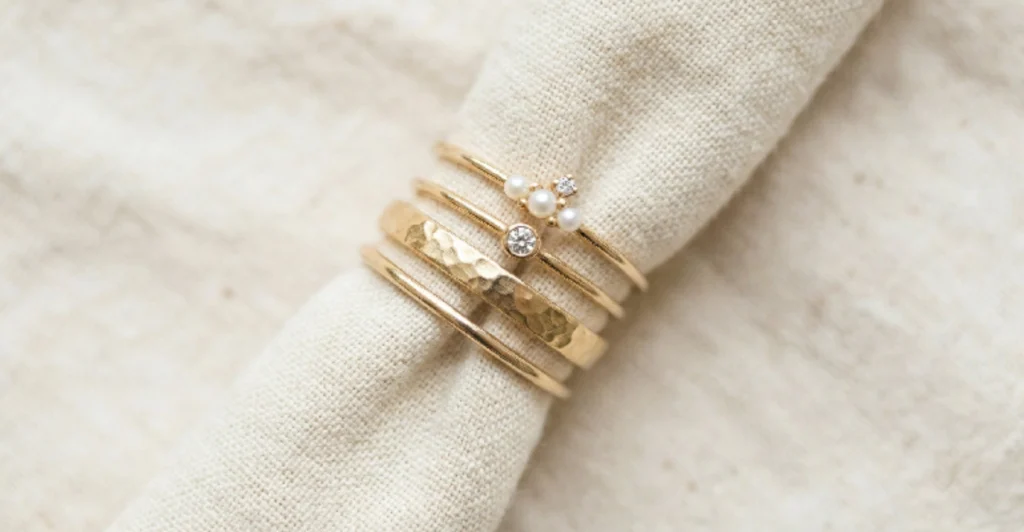
Ring stacking is one of the most personal forms of jewellery expression available — the combination of metals, textures, and proportions across multiple fingers creates something that’s almost impossible for two people to replicate exactly, even using the same pieces. The stack looks like you because no one else would assemble the same combination in the same way for the same reasons.
The practical challenge is buying rings that hold up to the specific stress of stacking — daily contact with each other and with surfaces, the friction between adjacent rings, the accumulation of soap and product in the gaps between stacked pieces. The rings that survive stacking are the ones made from materials that withstand this rather than revealing base metal or losing their plating within weeks.
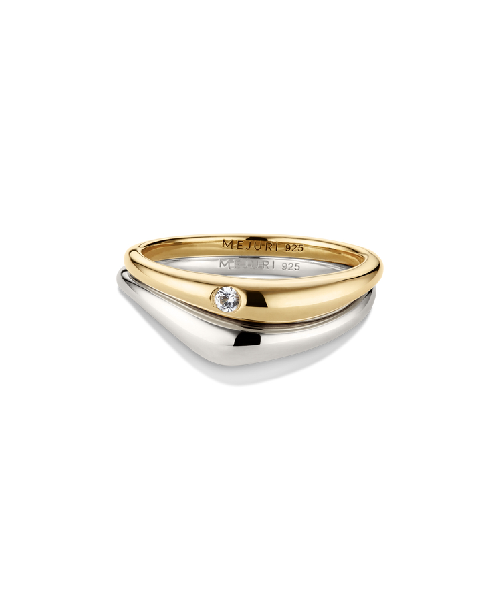
Mejuri produces stacking rings in solid 14k gold that are the most straightforward answer to building a ring stack that will last indefinitely. The Thin Band and the Demi-Fine Beaded Band are the two most consistently recommended pieces for starting a stack — both are simple enough to work with almost any combination and quality enough to maintain their appearance through the daily wear that ring stacking involves.
The key advantage of solid gold for stacking specifically: adjacent rings rub against each other with every hand movement. Gold rubbing on gold produces no degradation. Gold-fill rubbing on gold-fill produces minimal degradation. Gold-plated rubbing on gold-plated produces the specific plating wear at contact points that reveals base metal faster than almost any other form of jewellery use.
The Mejuri Demi-Fine Stacking Set (typically three coordinated thin bands in different textures) provides a considered starting point for a stack — the pieces are designed to work together while being versatile enough to integrate with other pieces from different brands or price points.
Price: $95-145 per ring, $245-395 for curated sets
Available at: Mejuri directly (mejuri.com)
Best for: Those building a solid gold stack that will last indefinitely.
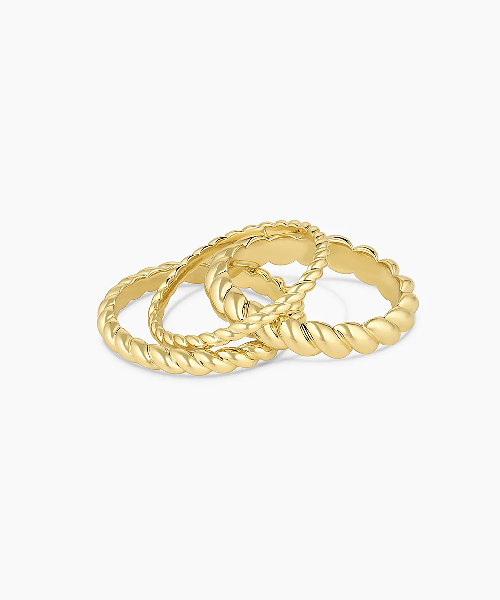
Gorjana’s ring range applies the same gold-fill quality to rings that their necklaces demonstrate — thick 18k gold over sterling silver that withstands the friction of stacking better than plated alternatives. The Power Gemstone Ring, the Arc Ring, and the Simple Band are the three pieces most recommended for stacking.
The gold-fill material holds up to ring stacking friction significantly better than plated alternatives — the layer thickness means contact between adjacent rings doesn’t wear through to base metal within a season of use the way plated rings do. With normal stacking use, Gorjana’s gold-fill rings maintain their appearance for two to four years before any signs of wear appear at contact points.
At $35-65 per ring, Gorjana allows building a larger, more varied stack at accessible prices — the ability to buy five or six rings at $35-50 each enables more experimentation with combinations than a stack built entirely from solid gold pieces at $95-150 each.
Price: $35-65 per ring
Available at: Gorjana directly (gorjana.com), Nordstrom
Best for: Those who want gold-fill quality for a multi-ring stack at accessible pricing.
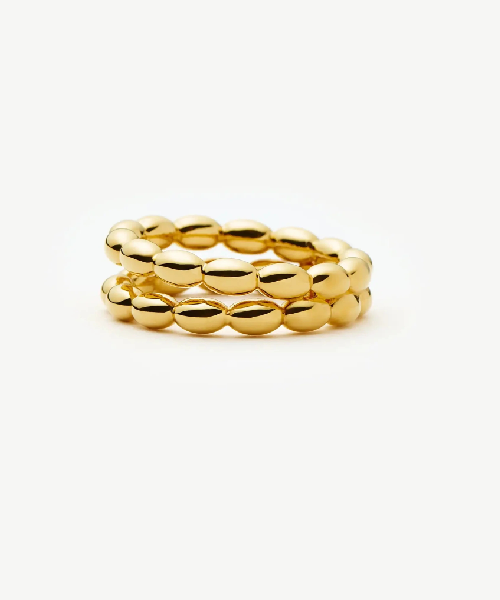
Missoma’s ring range is specifically designed for mixed metal stacking — the brand produces coordinated pieces in both gold vermeil and sterling silver that are specifically calibrated to work together as a mixed metal stack. The pieces share design language (the same proportional system, the same design vocabulary) while using different metals, which makes the mixing read as intentional rather than accidental.
Mixed metal stacking is one of the most current and visually interesting approaches to ring wear, and Missoma’s coordinated range removes the guesswork from making it work. The Bevelled Edge Ring in gold vermeil alongside the Plain Stacking Band in sterling silver, worn on the same or adjacent fingers, is the specific combination that reads as deliberately mixed.
Price: $55-90 per ring
Available at: Missoma directly (missoma.com), ASOS, Net-A-Porter
Best for: Those who want to build a mixed metal stack with pieces designed to work together.
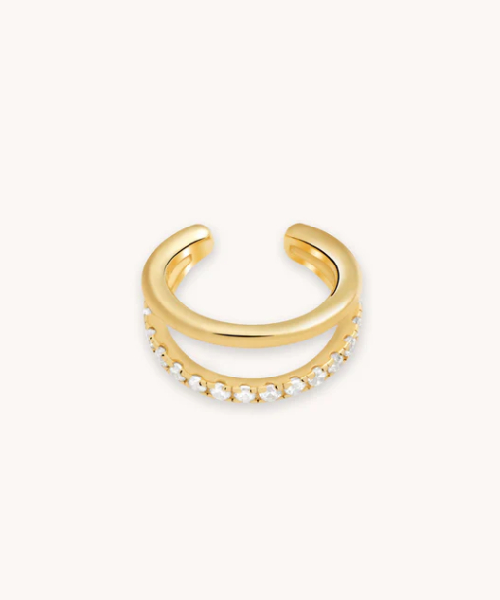
Astrid & Miyu’s ring and ear cuff collection is specifically designed for the curated, editorial jewellery look that has driven the brand’s social media following. The rings work as individual pieces but are specifically designed to coordinate with their ear cuff collection for the head-to-toe-to-ear jewellery approach that the brand champions.
The textured, organic forms in the Astrid & Miyu ring range — the twisted bands, the hammered textures, the organic shapes — provide visual interest in a stack beyond what smooth bands alone produce. A single textured Astrid & Miyu ring alongside several smooth gold and silver bands creates the variation that makes a stack look curated rather than simply multiple rings.
Price: $45-85 per ring
Available at: Astrid & Miyu directly (astridandmiyu.com)
Best for: Those who want textural interest and contemporary design in their ring stack.
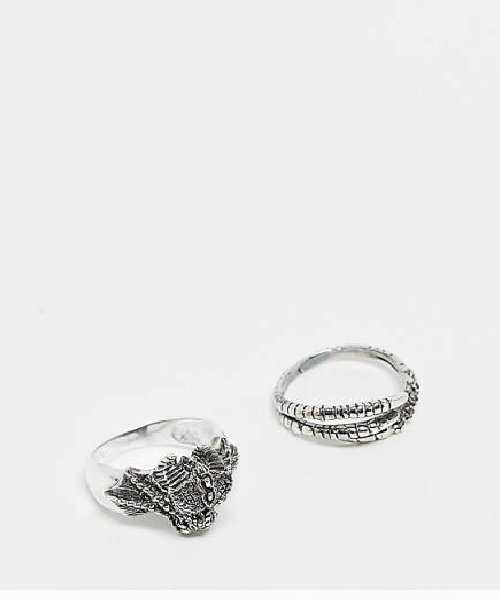
ASOS’s sterling silver ring sets — typically five to seven rings sold together at a single price — provide genuine sterling silver for building a stack at a price that makes the experiment financially low-stakes. The sets are styled to work together and include variation in finish (polished, hammered, textured) that produces interest without requiring separate research into combination compatibility.
The tarnish behavior applies identically to these as to any sterling silver — regular polishing and appropriate storage maintains their appearance. For building the initial stack to understand which proportions, positions, and combinations you actually prefer before investing in more expensive pieces, the ASOS set approach is genuinely sensible.
Price: $25-45 per set
Available at: ASOS directly (asos.com)
Best for: Those who want to experiment with ring stacking at the lowest possible investment.
Start with one anchor piece. The ring stack that looks intentional almost always has one piece that’s slightly more significant than the others — a stone ring, a wider band, or a piece with distinctive design — that the other rings build around. Starting with this anchor piece and adding thinner bands around it produces more coherent results than accumulating multiple similar rings.
Vary the texture. A stack of smooth bands looks less interesting than a combination of smooth, hammered, twisted, and beaded textures at the same proportional width. The variation in surface quality is what makes a stack look collected rather than uniform.
Consider the finger distribution. Rings concentrated on one or two fingers with others bare looks different from rings distributed across multiple fingers — both are valid but the effect is different. Deciding which approach suits your aesthetic before buying determines how many pieces of which sizes you need.
The ring stack is the most personal jewellery expression in the accessory category, and building one that lasts requires understanding the material choices. Mejuri solid gold is the lifetime investment that withstands the specific friction of stacking indefinitely. Gorjana gold-fill provides quality stacking rings at accessible prices for those who want longevity without solid gold investment. Missoma’s coordinated mixed metal range removes the guesswork from metal mixing. Astrid & Miyu adds textural interest and contemporary design. And ASOS sterling silver sets provide the lowest-investment starting point for discovering which combinations you actually like. Whatever you build, start with quality materials in the pieces you’ll wear most centrally — the anchor pieces that define the stack deserve the most durable materials.