HOME | Fashion | Beauty | Home Furnishing | Comparison | Top Reviews |
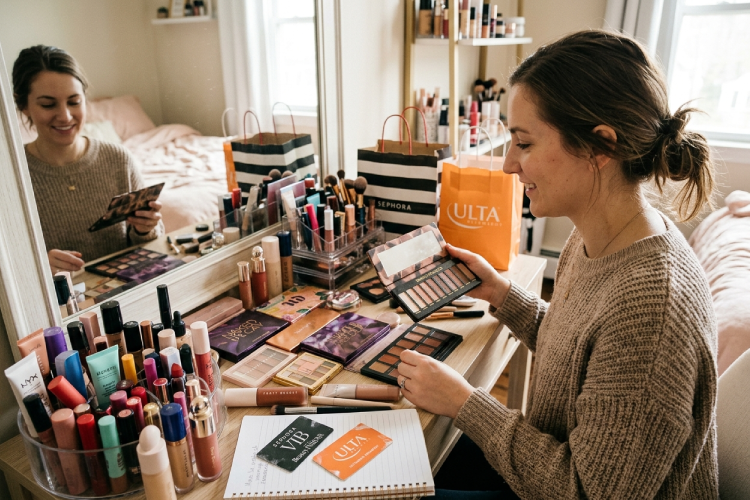
There’s a specific frustration that comes with belonging to two loyalty programs simultaneously and watching points accumulate in both places without ever quite reaching the redemption level that makes them feel worthwhile. I did this for about two years before I sat down and actually worked out what my spending was doing for me in each program.
That exercise changed how I shop. Not dramatically. But meaningfully enough that I think most people who split their beauty spending between Sephora and Ulta without a deliberate strategy are leaving something on the table.
This comparison isn’t going to tell you one store is better. They serve genuinely different purposes and there are real reasons to use both. But it’s going to tell you how to get the most out of each one, and which to prioritize if you have to pick.
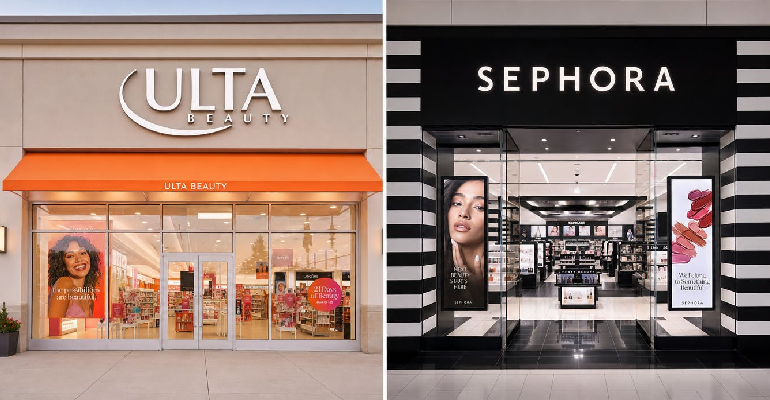
Sephora opened in France in 1970 and came to the United States in 1998. The model was innovative for its time: a beauty specialty retailer where you could pick up and test products freely, staffed by people with specific beauty expertise rather than cosmetic counter reps whose loyalty was to a single brand. The black and white aesthetic, the open floor plan, the sampling culture — all of it was deliberate and all of it communicated a specific thing: this is where beauty enthusiasts come, not where people come to reluctantly buy something they need.
The brand mix at Sephora has always leaned prestige. Charlotte Tilbury, Tatcha, Drunk Elephant, Rare Beauty, Fenty Beauty — these are the brands Sephora either had first or has most completely. The drugstore tier is essentially absent. You go to Sephora for mid-range to high-end beauty and nothing else.
Ulta Beauty launched in 1990 in Illinois and made a different bet entirely. The format — prestige brands and drugstore brands under one roof, with a salon in the back — shouldn’t have worked as coherently as it does. The conventional wisdom in retail was that prestige beauty needed its own environment, that putting La Mer next to L’Oreal would cheapen both. Ulta proved that wrong. The customer didn’t care about the theoretical hierarchy of the beauty retail world. They cared about getting everything in one trip and collecting points on all of it.
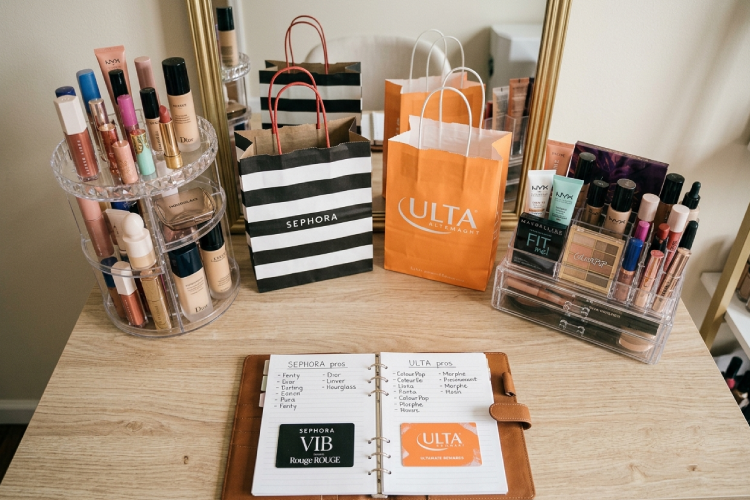
Sephora’s Beauty Insider runs on a three-tier system. Free to join as Insider, VIB requires $350 in annual spending, Rouge requires $1,000. The points rate is one point per dollar at all tiers.
The redemption is where things get complicated. Points can be used for sample kits (which have gotten smaller and less compelling over time), for rewards during the bi-annual sales, or toward product redemptions that rarely land at good value per point. The most useful thing about being Rouge is the 20% discount during the annual Rouge sale event, which for someone spending $1,000+ per year represents genuinely significant savings. For people who don’t hit $1,000, the program is more about access (early access to launches, invitations to events) than about cash value.
Ulta’s Ultamate Rewards is simpler and more immediately tangible. One point per dollar at the base, 1.25 points at Platinum ($500 annual spend), 1.5 points at Diamond ($1,200). Every 100 points is $3 off a future purchase. There is nothing confusing about this. You spend money, you get points, points become dollars. The math is easy, the value is consistent.
The 21 Days of Beauty sale — where Ulta offers a different prestige product at 50% off each day for twenty-one days — is the single best beauty deal event that runs annually. Products from brands like Too Faced, Urban Decay, and IT Cosmetics at genuine half-price for twenty-four hours. It requires planning and some shopping-day-of energy, but for someone who buys prestige cosmetics regularly, this event alone can justify the loyalty.
This is the practical question that overrides loyalty program math for many shoppers.
Charlotte Tilbury is exclusive to Sephora in the US. If Charlotte Tilbury is in your regular rotation — and the Flawless Filter and the Beautiful Skin Foundation have earned their reputations — this ends a portion of the comparison. You’re going to Sephora for Charlotte Tilbury regardless of points calculations.
Rare Beauty (Selena Gomez) is Sephora-exclusive in retail. So is Fenty Beauty for the core range. So is Drunk Elephant.
Ulta carries brands that Sephora doesn’t — Morphe has a stronger presence at Ulta, as do some of the mid-tier brands that sit between drugstore and prestige. The drugstore coverage at Ulta is complete: L’Oreal, Maybelline, NYX, e.l.f., Neutrogena, CeraVe — all available, all points-eligible. If any portion of your beauty spending goes toward drugstore products (and most people’s does, even people who primarily buy prestige), Ulta is capturing value that Sephora isn’t.
The Kylie Cosmetics and ColourPop presence at Ulta has also been significant. The brand that defined independent DTC cosmetics in the mid-2010s has a retail home at Ulta, not Sephora.
This is subjective and I know it, but it matters for how much you enjoy shopping.
Sephora is better for discovery. The store layout encourages browsing. The staff are trained specifically on the products in the store rather than on a single brand’s products. If you walk in without knowing exactly what you want and you’re open to being educated or redirected, Sephora’s environment is more suited to that experience. The sampling culture is also genuinely better at Sephora — more extensive, more encouraged, more available.
Ulta is better for efficiency. You know what you want, you get it, you get points on everything including the CeraVe you grabbed from the drugstore end, maybe you get a blowout in the salon. The one-stop shop quality is a genuine practical advantage for people who buy across the beauty tier spectrum.
The Sephora inside JCPenney (now a partnership with Kohl’s) is a different experience again — smaller, less staffed, sometimes less well-stocked. Worth knowing when you’re choosing between locations.
Sephora does better: skincare discovery and education, prestige exclusives, the seasonal sale events for higher spenders, the in-store sampling experience, and the staff expertise on specific product lines.
Ulta does better: points value per dollar spent, drugstore product access with points earning, the 21 Days of Beauty event, haircare selection and the salon service, and the overall value proposition for shoppers who buy across multiple price tiers.
Don’t treat this as a zero-sum choice. Use Sephora for brands you can only get there and for the sale events if you’re a Rouge member. Use Ulta for everything else — drugstore purchases, brands available at both, and to hit the 21 Days of Beauty sales strategically.
If you have to pick just one: Ulta, unless your spending is dominated by Sephora exclusives. The points program returns more tangible value and the brand selection covers most of what most people actually buy.
If Charlotte Tilbury is a non-negotiable and you spend less than $350 per year on beauty: Sephora for Charlotte Tilbury, Ulta for everything else.