
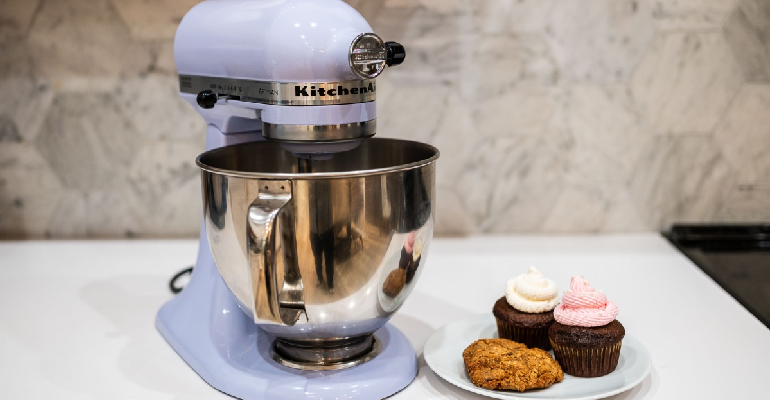
KitchenAid stand mixers have occupied the kitchen counter in American homes since 1919 — a 100-year-plus presence that has produced genuine brand loyalty, multi-generational heirloom machines, and a product whose fundamental engineering has remained largely unchanged because the fundamental engineering is excellent. The question in 2026 is not whether to buy a KitchenAid but which model to buy — because the model decision is more consequential than most buyers realise, with motor power differences that directly determine whether the mixer will handle your specific baking tasks or struggle through them.
The most important positive evidence is specific: America’s Test Kitchen’s 2026 stand mixer comparison selected the KitchenAid Classic Series 4.5-Quart Tilt-Head Stand Mixer as the recommendation for solid performance at a moderate price — a validation from the publication that tests kitchen equipment more rigorously than any other consumer source, placing the Classic above alternatives including Cuisinart and Instant at comparable price points. The most important negative evidence is equally specific: the Classic’s 275-watt motor struggled with heavy bread dough beyond 2 pounds in documented independent testing, and the Artisan’s 325-watt motor worked audibly harder with stiff doughs than the 7-Quart Bowl-Lift’s 1.3 HP motor — a power hierarchy that makes model selection a genuine performance decision rather than an aesthetic one.
✅ America’s Test Kitchen 2026 recommends the KitchenAid Classic Series 4.5-Quart Tilt-Head Stand Mixer for solid performance at a moderate price — the most credible independent testing recommendation in the kitchen appliance category
✅ KitchenAid Artisan Series 5-Quart Tilt-Head Stand Mixer at $499.99 offers 40-plus colourways including seasonal editions — the most colour-diverse stand mixer range in the category and the most recommended model for the majority of home bakers
✅ KitchenAid 7-Quart Bowl-Lift Stand Mixer from $599.95 with 1.3 HP motor — documented as capable of kneading 4 pounds of 50% whole wheat dough without temperature rise, the definitive bread baker’s recommendation
✅ Over 15 optional hub-powered attachments available across the KitchenAid attachment ecosystem — pasta maker, food grinder, vegetable spiraliser, ice cream maker, meat grinder — making the stand mixer a documented culinary centre beyond mixing
✅ KitchenAid Artisan Mini 3.5-Quart at $329.99 — recommended by America’s Test Kitchen for buyers where counter space is a concern, with the same tilt-head design in a smaller form factor
✅ 4.7/5 or higher ratings across all major models at Walmart from thousands of verified buyers — a review volume that provides meaningful quality signal at a scale individual publication tests cannot replicate
✅ Multi-decade documented durability — the specific KitchenAid advantage that no comparable alternative at the price point matches, with buyers describing machines purchased in the 1990s still in active use
❌ Classic’s 275-watt motor documented as struggling with heavy bread dough beyond 2 pounds — buyers who want to bake bread regularly should step up to the Artisan (325W) or the 7-Quart Bowl-Lift at minimum
❌ Price premium over alternatives including Cuisinart and Instant is real — for buyers whose primary use is light baking (cakes, cookies, occasional bread), lower-cost alternatives deliver comparable functionality at meaningfully lower prices
❌ Black Friday and spring seasonal sales documented at $50–$100 off most models — buyers who can time the purchase to sale events should not pay full price
❌ Tilt-head models require 16–17 inches of clearance when tilted back — buyers must measure under-cabinet clearance before ordering, a specific spatial requirement that surprises buyers who do not check before purchasing
❌ The 7-Quart Bowl-Lift at 29-plus pounds is the heaviest consumer stand mixer option — buyers who plan to move the mixer frequently should consider whether the Pro 600 series’ bowl-lift mechanism and weight suit their kitchen workflow
❌ Attachments sold separately — the price of a KitchenAid with a full attachment suite (pasta maker, meat grinder, food processor bowl) is meaningfully higher than the mixer purchase price alone
This review draws on America’s Test Kitchen’s June 2026 stand mixer comparison, WhiskandBite’s May 2026 KitchenAid model guide, Everything Kitchens’ 2026 stand mixer comparison, Walmart’s verified buyer review data across KitchenAid models, and KitchenAid’s own published product specifications. No commercial relationship with KitchenAid. No affiliate link influences any rating or conclusion.
KitchenAid is an American kitchen appliance brand owned by Whirlpool Corporation, producing stand mixers since 1919 and expanding into food processors, blenders, coffee makers, and other countertop appliances. The stand mixer is the brand’s flagship and most iconic product — produced in Greenville, Ohio, which KitchenAid publishes as a specific US manufacturing commitment. The current stand mixer range covers the Classic Series (4.5-Qt, 275W), the Deluxe Series (4.5-Qt, 300W), the Artisan Series (5-Qt, 325W and 5.5-Qt bowl-lift), the Artisan Mini (3.5-Qt, 250W), the Design Series, and the 7-Quart Bowl-Lift. The mixer power hub accepts over 15 optional attachments that extend the machine’s functionality beyond mixing.
The KitchenAid model decision is the specific area where most buyer confusion occurs, and where getting it wrong produces documented buyer frustration. The motor power hierarchy is real and consequential: the Classic at 275W struggles with heavy bread dough beyond 2 pounds. The Artisan at 325W handles most tasks beautifully but works audibly harder with stiff doughs. The 7-Quart Bowl-Lift at 1.3 HP kneaded 4 pounds of 50% whole wheat dough without temperature rise in independent testing — the documented performance difference is not subtle.
For buyers who primarily bake cakes, cookies, muffins, and occasional light bread: the Classic at its documented moderate price is the right recommendation per America’s Test Kitchen. For buyers who bake bread regularly, make pizza dough, or mix heavy batters frequently: the Artisan’s 325-watt motor is the minimum practical recommendation, with the 7-Quart Bowl-Lift the documented choice for serious bread bakers. For buyers where counter space is a constraint: the Artisan Mini at 3.5 quarts and 250 watts is the documented space-saving recommendation, with the explicit acknowledgement that the 250-watt motor is best suited for lighter batters and standard recipes.
The KitchenAid Artisan Series 5-Quart Tilt-Head Stand Mixer at $499.99 is the model that America’s Test Kitchen and most independent kitchen equipment reviewers position as the majority recommendation for home bakers — the balance of motor power (325W), bowl capacity (5 quarts, sufficient for 6-9 dozen cookies or 4 loaves of bread per batch), and the colour ecosystem (40-plus colourways including the Wildflower Ceramic Bowl edition) that has made it the documented best-selling stand mixer in the US market.
The tilt-head design requires 16–17 inches of clearance when tilted back — a specific spatial requirement that buyers must measure under-cabinet clearance for before purchasing. The bowl-lift mechanism in the 7-Quart avoids this spatial requirement, which is the specific design advantage of the bowl-lift configuration for buyers with limited under-cabinet clearance.
The KitchenAid attachment ecosystem is the specific long-term value proposition that justifies the price premium over lower-cost alternatives. The pasta maker attachment, the food grinder, the spiraliser, the ice cream maker, the meat grinder, and over 15 other hub-powered attachments all connect to the power hub present on every KitchenAid stand mixer across models. For buyers who purchase multiple attachments over time, the stand mixer becomes a documented culinary centre that replaces multiple single-function appliances.
The attachment price must be factored into any total cost comparison: popular attachments include the pasta maker ($149.99), the food grinder ($49.99), and the spiraliser with peel, core, and slice ($79.99). A fully equipped KitchenAid with multiple attachments represents a substantially higher investment than the mixer purchase price alone.
The multi-decade durability documentation is KitchenAid’s most specific competitive advantage over lower-cost alternatives. Buyers describing KitchenAid mixers purchased in the 1990s still in active daily use are documented across multiple review platforms — a 25-plus year operational lifespan that no Cuisinart or Instant model at comparable or lower price points has accumulated equivalent documentary evidence for. The initial price premium versus lower-cost alternatives is most defensible when amortised over a 20-to-30 year ownership timeline.
The annual cost calculation at a 25-year lifespan makes the Artisan’s $499.99 purchase approximately $20 per year — a specific framing that the multi-decade durability documentation supports and that makes the price premium over $200 alternatives significantly less consequential when ownership timeline is factored in.
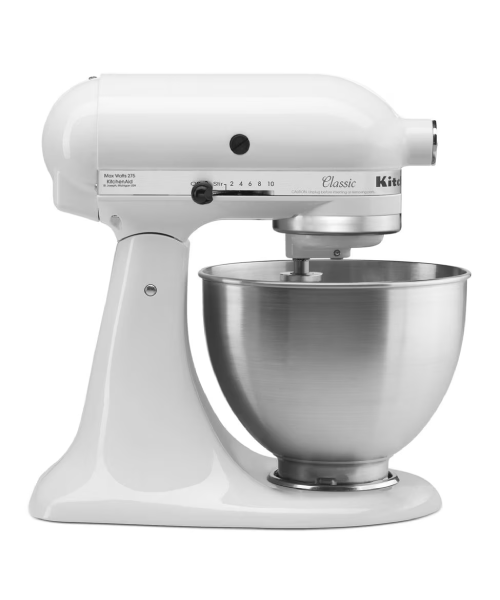
America’s Test Kitchen’s 2026 recommendation for solid performance at a moderate price — the entry point into the KitchenAid ecosystem with a 275-watt motor appropriate for cakes, cookies, and light bread. For buyers whose primary baking does not involve heavy doughs or large-batch bread, the Classic is the documented value recommendation. Available in Onyx Black and a limited range of core colours.
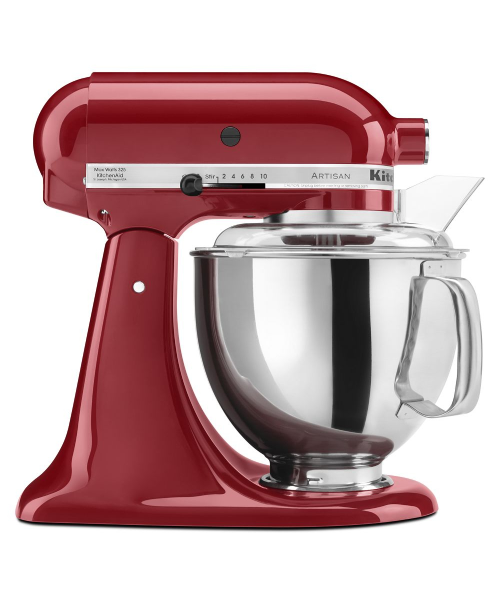
The majority recommendation for home bakers — 325-watt motor, 5-quart bowl, 40-plus colourways including the Wildflower Ceramic Bowl edition. The documented best-selling KitchenAid model with the most independent reviewer validation across the current range. The specific model recommendation for buyers who bake bread occasionally alongside other baking and want a versatile, well-powered machine.
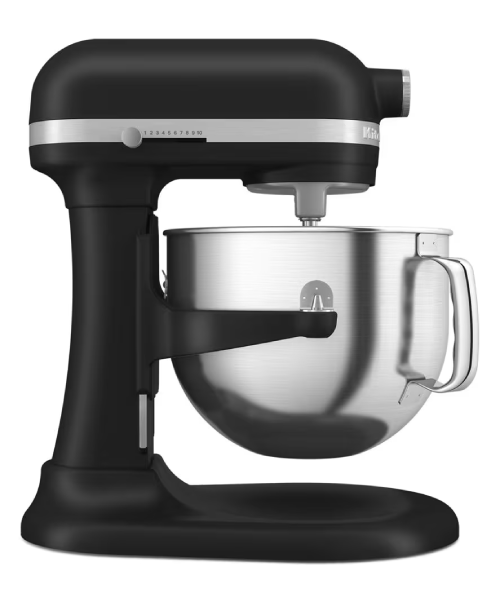
The documented recommendation for serious bread bakers — 1.3 HP motor that handled 4 pounds of 50% whole wheat dough without temperature rise in independent testing, 7-quart bowl capacity for large-batch baking, and bowl-lift mechanism that eliminates the under-cabinet clearance requirement of tilt-head models. Available in Blue Velvet and a range of standard and limited colourways. The 2026 update: the Pro 600 has been discontinued and replaced with this model.
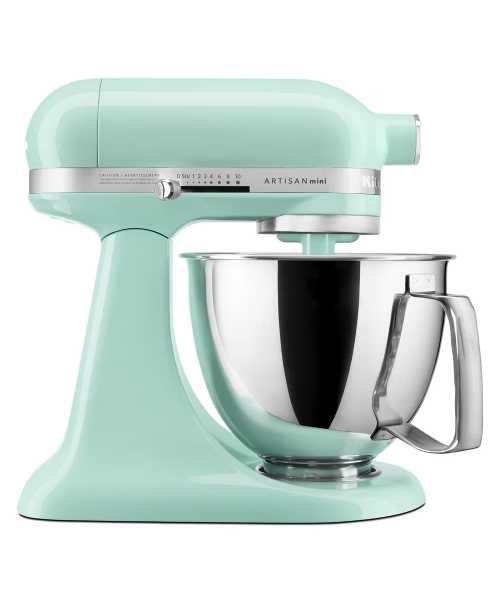
The documented recommendation where counter space is a constraint — same KitchenAid build quality and tilt-head design in a smaller form factor with a 250-watt motor best suited for lighter batters and standard recipes. America’s Test Kitchen specifically recommends this model for buyers where space is the primary constraint. Note the 250-watt motor limitation for heavy doughs before purchasing.
An America’s Test Kitchen tester writing in June 2026 described the KitchenAid Classic as the recommendation for solid performance at a moderate price after testing stand mixers of nearly every size and price — and the KitchenAid 7-Quart Bowl-Lift as the recommendation for buyers who frequently do heavy-duty, large-batch baking, especially breads.
A buyer writing on Walmart in April 2026 described the Artisan Series 5-Quart as the machine she has owned for 12 years — noting the motor sounds exactly as it did when she bought it, the machine has not required any repairs, and she bakes bread twice weekly alongside regular cookie and cake baking.
A buyer writing on Walmart described the 7-Quart Bowl-Lift as the upgrade she made after overworking her Artisan making large batches of whole wheat bread — specifically noting the 1.3 HP motor does not audibly strain on the same doughs that made the Artisan work noticeably harder.
A buyer writing on Reddit’s r/AskBaking in March 2026 described purchasing the Classic based on price, immediately encountering audible motor strain when making a 3-pound batch of rye bread, and recommending that buyers who plan any regular bread baking start with the Artisan at minimum.
A buyer writing on Walmart described inheriting a KitchenAid Artisan her mother purchased in 1999 — 27 years of regular use with no mechanical failures — and describing it as the most durable kitchen appliance she had ever encountered.
For buyers who will own the machine for 10-plus years and bake regularly: yes — the multi-decade durability documentation makes the price premium over lower-cost alternatives defensible when amortised across the ownership timeline. The attachment ecosystem is a specific additional value that accumulates over years of ownership.
For buyers who bake occasionally and are price-sensitive: lower-cost alternatives including Cuisinart deliver comparable functionality for lighter baking tasks at lower purchase prices with less documented longevity.
For buyers selecting between KitchenAid models: the model selection is more consequential than the brand decision — the motor power hierarchy directly determines whether the machine will handle specific baking tasks without strain.
KitchenAid Artisan 5-Qt | KitchenAid 7-Qt Bowl-Lift | Ankarsrum Original 7L | Cuisinart SM-50 5.5-Qt | Instant Stand Mixer Pro | |
Price | $499.99 | from $599.95 | $749 | $399.95 | $199.95 |
Motor | 325W | 1.3 HP | High-powered | 500W | 600W |
Bowl capacity | 5 quarts | 7 quarts | 7 litres | 5.5 quarts | 7.4 quarts |
Attachment ecosystem | ✅ 15+ attachments | ✅ Same hub | ❌ Different | Limited | Limited |
US manufacturing | ✅ Greenville, OH | ✅ Same | Sweden | China | China |
Multi-decade durability | ✅ Documented extensively | ✅ Same | ✅ Documented | Limited documentation | Limited documentation |
Colour range | ✅ 40+ colourways | 8–12 colours | Limited | Limited | Limited |
America’s Test Kitchen 2026 | ✅ Recommended (Classic and Mini) | ✅ Heavy-duty pick | ✅ Top pick for bread | Not top pick | Not tested |
Best for | Majority home bakers | Serious bread bakers | Bread + heavy mixing | Value + power | Budget entry |
kitchenaid.com — direct, with the full model and colourway range. Also available at Williams Sonoma, Best Buy, Walmart, and Target. Black Friday and spring seasonal sales are documented at $50–$100 off most models — the most financially significant timing consideration for buyers who can plan their purchase around sale events. Measure under-cabinet clearance (16–17 inches needed when tilted) before purchasing a tilt-head model.
For light baking (cakes, cookies): the Classic at its documented moderate price. For most home bakers including occasional bread: the Artisan 5-Quart at $499.99. For regular bread baking and large batches: the 7-Quart Bowl-Lift from $599.95. For limited counter space: the Artisan Mini at $329.99.
For buyers who will own the machine for 10-plus years and bake regularly: yes — the multi-decade documented durability makes the price premium defensible when amortised over the ownership lifetime. For occasional bakers: lower-cost alternatives deliver comparable functionality at lower prices.
Tilt-head models (Classic, Artisan, Artisan Mini) require 16–17 inches of under-cabinet clearance when tilted back. Bowl-lift models (7-Quart) do not have this clearance requirement. Measure before purchasing.
Yes — but motor power matters specifically for bread. The Classic (275W) struggled with heavy bread dough beyond 2 pounds in testing. The Artisan (325W) handles most bread tasks. The 7-Quart (1.3 HP) is the documented choice for regular large-batch bread baking.
Yes — Black Friday and spring seasonal sales are documented at $50–$100 off most models. Buyers who can time the purchase to these events should not pay full price.
KitchenAid makes the most specifically documented long-term-durable stand mixer in the consumer market — the multi-decade ownership accounts, the US manufacturing transparency, and America’s Test Kitchen’s 2026 recommendation validation all support the brand’s position at the head of the category. The attachment ecosystem’s long-term value compounds the initial investment for buyers who add functionality over time.
The model decision is the most consequential pre-purchase step — motor power differences between the Classic (275W), Artisan (325W), and 7-Quart Bowl-Lift (1.3 HP) are real, tested, and directly determine whether the machine handles your specific baking without strain. Buy at sale pricing — $50–$100 off is documented as recurring — and measure under-cabinet clearance before purchasing a tilt-head model.
Category | Score |
Artisan 5-Qt Overall Performance | 9.0 / 10 |
7-Qt Bowl-Lift (bread baking) | 9.5 / 10 |
Classic (light baking value) | 8.0 / 10 |
Multi-Decade Durability | 9.5 / 10 |
Attachment Ecosystem Value | 9.0 / 10 |
Colour and Aesthetic Range | 9.5 / 10 |
Full-Price Value | 7.5 / 10 |
Sale-Price Value | 9.0 / 10 |
Overall | 8.8 / 10 |