HOME | Fashion | Beauty | Home Furnishing | Comparison | Top Reviews |

Kitchen organization content on social media is almost entirely aspirational fantasy. The pantries that are decanted into uniform labeled containers, organized by color, with every item visible and perfectly proportioned, exist primarily on TikTok and belong to people whose relationship with their kitchen pantry is as performance rather than as the place where they actually keep food.
Real kitchen organization has one goal: reducing friction. Making the things you use most accessible and the things you use least out of the way. Minimizing the time between “I want to cook” and “I am cooking.” Everything that serves that goal is worth doing. Everything that doesn’t serve it is theater.
Counter space is eaten primarily by three categories of objects: appliances used infrequently stored where frequently used appliances should be, objects that arrived on the counter and never moved, and things waiting to be used that would be better stored somewhere else.
The exercise that solves this: for two weeks, don’t put anything away — just move things that go unused into a box. At the end of two weeks, see what’s in the box. Those items don’t belong on the counter. The things that are still out — the items you reached for and used during those two weeks — are the things that deserve counter space.

Most kitchens have three to four appliances on the counter that should be in a cabinet (the panini press used twice a year, the juicer that’s been there since January, the second coffee maker from a gift that duplicates the one you already use). Moving these to a cabinet immediately recovers significant counter space without buying anything.
Pan organization is the problem that has more solutions than any other kitchen storage challenge and fewer good ones than the number of solutions would suggest. The magnetic pan rack that Caraway includes with their set is the best consumer product in this category — it allows pans to be stored vertically, accessible individually without moving others, on a countertop. For people who don’t want a countertop rack, a vertical pan organizer that sits inside a cabinet (around $15-25 on Amazon, the Lynk Professional Roll-Out Cabinet Organizer is the one with consistent reviews) does the same job inside a cabinet.
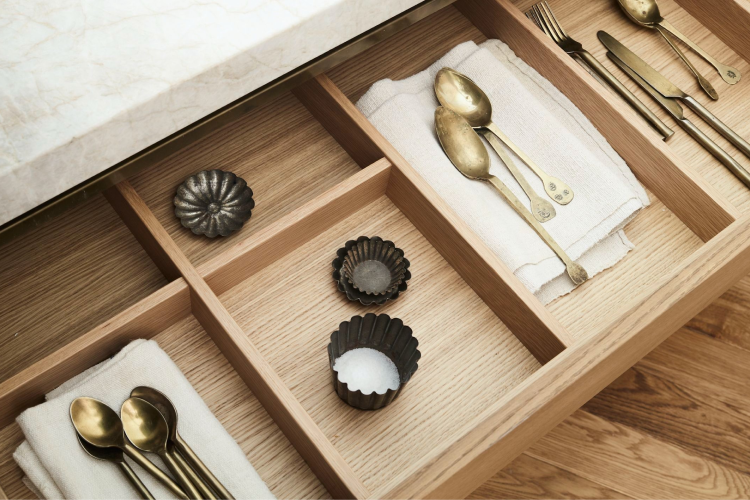
Drawer dividers for utensil drawers — the kitchen utensil drawer that everyone has where everything tumbles together and finding the peeler involves moving six wooden spoons — are worth the $15-20 they cost. The OXO Good Grips Drawer Organizer allows customizable divider placement. The drawer goes from frustrating to functional in fifteen minutes.
Shelf risers inside cabinets. The space between cabinet shelves is usually taller than necessary for any single item, which means either stacking (unstable, items at the bottom are inaccessible without moving everything above) or wasted space. A shelf riser — essentially a small shelf that sits inside the cabinet, doubles the usable levels within the same cabinet height — costs $15-25 and immediately doubles the storage capacity of any cabinet where stacking was the previous strategy.
The lazy Susan inside a corner cabinet or deep cabinet. Anything at the back of a cabinet that you can’t see or reach doesn’t exist for cooking purposes. A lazy Susan brings the back of the cabinet to the front with a single spin, making items accessible that would otherwise be unreachable without removing everything in front.
Decanting pantry staples into clear, labeled containers looks organized and has legitimate practical benefits for specific items. Flour and sugar in airtight containers stay fresher longer and take up a consistent, predictable shape. Cereals in airtight containers don’t go stale. Coffee in an airtight container stays fresher than in its bag after opening.
The honest version of this: you don’t need to decant everything. Rice that you go through in two weeks doesn’t need to be in a special container — it’s fine in the bag. The bag of almonds you eat from directly doesn’t need a container. The spice that you use occasionally doesn’t need to be in a matching uniform jar with a label.
Decant the things where the airtight storage provides genuine benefit (flour, sugar, coffee, cereals, pasta, loose grains). Leave everything else in its original packaging. The aspiration to have every pantry item in matching containers is an aesthetic one, not a functional one, and aesthetic aspirations that require constant maintenance (the refilling, the labeling, the reorganizing when something doesn’t fit) often produce more work than they eliminate.
Refrigerator organization has the same friction-reduction goal as the rest of kitchen organization. The fridge that stays organized is the fridge where the most frequently accessed items are at eye level, raw meat is stored on the lowest shelf (to prevent contamination drips onto food below), and leftovers are in clear containers so they’re visible rather than forgotten.
Clear containers for leftovers are genuinely worth buying. Opaque containers mean food gets forgotten, discovered a week later, and wasted. Clear containers mean you see what’s there every time you open the fridge. The Pyrex Simply Store set is the reference — glass, clear, oven-safe, stackable, dishwasher safe. Around $25-35 for a set of ten.
A lazy Susan inside the fridge — specifically on the condiment shelf or wherever jars accumulate — produces the same benefit as a cabinet lazy Susan: items at the back become accessible. A small turntable from IKEA ($5-10) does this effectively.
The produce drawer problem: most produce drawer use is poor because the humidity setting is either unknown or wrong. The low-humidity drawer (often labeled “crisper”) is for fruits. The high-humidity drawer is for leafy vegetables. Fruits produce ethylene gas that accelerates ripening/spoiling in vegetables if stored together, which is why the drawers exist and why the separation matters.