HOME | Fashion | Beauty | Home Furnishing | Comparison | Top Reviews |
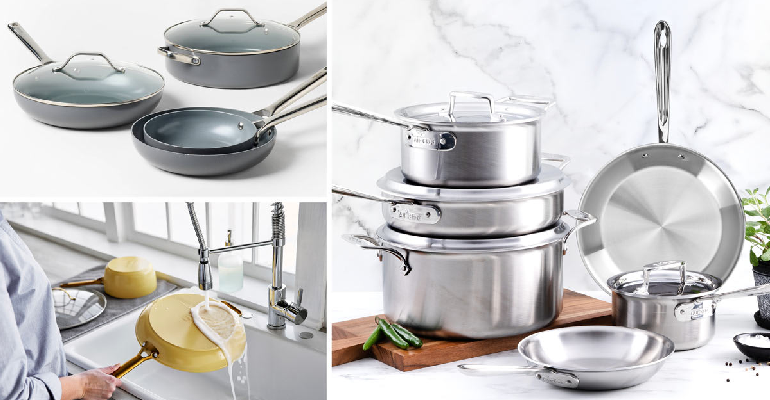
The nonstick cookware category has a marketing problem. Every brand claims their coating is the most durable, the most non-toxic, the most scratch-resistant, and the longest-lasting. Some of these claims are truer than others. None of them are completely honest about the fundamental reality of nonstick cookware, which is this: all nonstick coatings degrade over time. The only questions are how quickly, under what conditions, and what you can do to slow the process.
I’ve tested nonstick pans at multiple price points over years rather than weeks. Here’s what that experience actually produces.
Before comparing brands, understanding what you’re actually comparing matters. The two main coating types in 2026 are PTFE (polytetrafluoroethylene, what was historically called Teflon) and ceramic (sol-gel coating, which is silicon-based). Both are nonstick. They work differently. They fail differently. They have different care requirements.
PTFE coatings are the traditional nonstick surface. The chemistry is extremely well understood — PTFE is chemically inert, stable at normal cooking temperatures, and produces exceptional nonstick performance. The health concerns about older Teflon coatings were largely about PFOA (a processing chemical), which has been phased out of manufacturing since 2013. Modern PTFE coatings are not the same product as the coatings people were concerned about fifteen years ago.
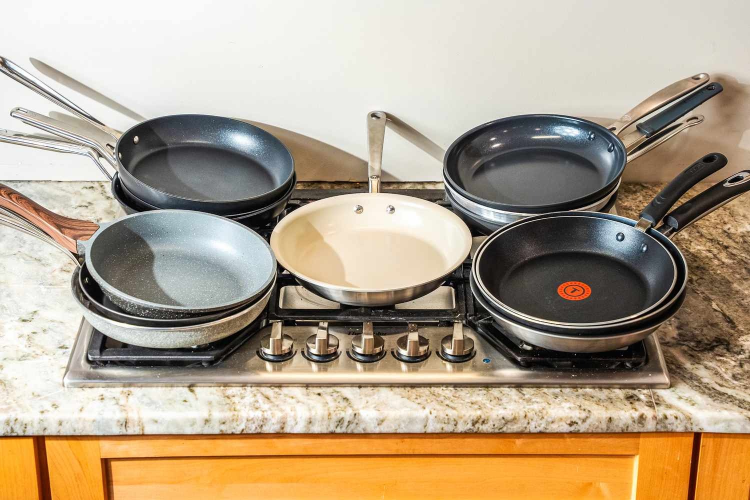
PTFE coatings fail primarily through abrasion — scratching with metal utensils, rough cleaning, stacking without protection. When the coating chips or flakes significantly, replacement is the appropriate response rather than continued use.
Ceramic coatings are the PTFE-free alternative that has grown enormously in market share over the last decade. They’re marketed as natural, chemical-free, and safer than PTFE. The ceramic surface is a sol-gel layer — essentially a thin glass-like coating — that provides nonstick properties initially but degrades through a different mechanism than PTFE: heat and use gradually cause the surface to lose its nonstick character even without visible damage. The coating doesn’t chip or flake in the same way — it just gradually stops working.
The honest comparison: PTFE typically lasts longer as a nonstick surface if not mechanically damaged. Ceramic is more heat-tolerant in the sense that occasional higher-heat cooking degrades it less catastrophically than it does PTFE, but over time the ceramic surface loses functionality faster. Neither is permanent. Both require care.
Caraway has become the reference brand for ceramic nonstick cookware in the US market, and the reputation is partially earned. The cooking surface releases food cleanly on low to medium heat. The design is genuinely considered — the colors are beautiful, the storage system that comes included is one of the most useful accessories in their category, and the overall presentation is a significant step above most cookware in its price range.
The coating performs well when used correctly. Correctly means: low to medium heat only, no metal utensils, no dishwasher, no cooking spray (which builds up a residue that degrades the coating faster than almost anything else). With these conditions maintained, Caraway holds its nonstick performance for one to two years of regular use.
Without these conditions maintained, the timeline shortens. High heat is the primary killer of ceramic coatings — it changes the surface structure at a molecular level and the nonstick property doesn’t return after the damage is done. Caraway is explicit about this in their care instructions. The reality is that many people don’t fully absorb this information and then experience degraded nonstick performance faster than expected.
The 4-piece set (fry pan, saucepan, sauté pan, Dutch oven) costs around $395. The individual fry pan is around $95. If budget is a consideration, starting with the fry pan alone is sensible — it’s the piece that demonstrates whether the care requirements of ceramic nonstick fit your cooking habits before committing to the full set.
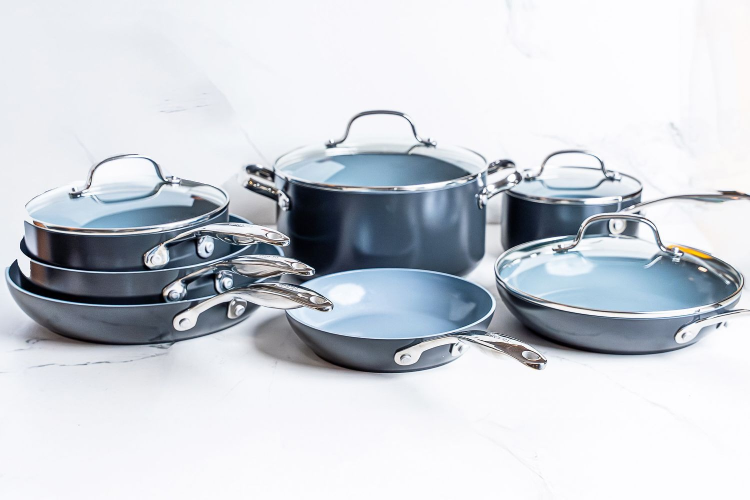
GreenPan pioneered the PTFE-free ceramic nonstick category in the early 2010s and their Thermolon coating remains competitive with newer entrants. The Valencia Pro collection is the range worth looking at — hard anodized aluminum body, oven-safe to 600°F, induction compatible, and sold at prices meaningfully below Caraway’s range.
The GreenPan Paris Pro or Valencia Pro 10-inch skillet costs around $50-60. It performs well in the same care conditions as Caraway. The coating longevity is comparable in my experience — GreenPan doesn’t have a significant advantage over Caraway in how long the surface maintains its nonstick properties, but it also doesn’t perform worse at a lower price point.
Where GreenPan differs from Caraway: the design is functional rather than decorative. The pans look like pans rather than like objects you’d want photographed in your kitchen. The storage system is not included. If aesthetics matter significantly to your decision, Caraway’s premium reflects that. If pure cooking performance at a lower price is the priority, GreenPan is a genuinely strong option.
T-fal makes PTFE-coated nonstick cookware at prices that make everything else on this list seem expensive. The T-fal E93808 Professional Total Nonstick pan costs around $30. It works. The nonstick performance when new is excellent — arguably better than ceramic alternatives at first use because PTFE produces a more frictionless surface initially than ceramic.
The durability honest conversation: at $30, T-fal pans are arguably priced correctly for what they are. Plan to replace them every two to three years. The PTFE coating, despite being mechanically more durable than ceramic, eventually develops small scratches from normal use that accumulate into an area where the performance degrades noticeably. With good care — silicone or wooden utensils, no dishwasher, no cooking spray — three years is achievable. Without those habits, eighteen months is more realistic.
The thermal indicator (a dot that turns red when the pan is at the right preheat temperature) is a genuinely useful feature for beginning cooks who haven’t developed the habit of testing pan heat before adding oil. It’s a small thing but it prevents one of the most common cooking mistakes.
HexClad has become one of the most marketed cookware brands in the world, largely through the Gordon Ramsay partnership. The hybrid surface — laser-etched stainless steel peaks with PTFE-coated valleys — is a genuinely different design approach that produces genuinely different cooking characteristics.
The stainless peaks get hot and produce real browning — this is a real advantage over fully coated nonstick surfaces that prevent the Maillard reaction from occurring properly. The PTFE valleys provide easier release than bare stainless and simpler cleanup. The design is clever.
The honest assessment of the trade-offs: HexClad is not as nonstick as a flat PTFE surface for delicate items. Eggs cooked in a new HexClad require more care than eggs cooked in a flat nonstick. The pan is better for searing and browning than for delicate work. The price ($150-180 for a single 12-inch pan) is genuinely high for a pan that performs better at some tasks and worse at others than dedicated alternatives.
Who HexClad makes sense for: cooks who want one versatile pan that handles both searing and easier cleanup without switching between pans, and who are specifically bothered by the inefficiency of owning and maintaining multiple pans for different cooking tasks.
Regardless of which nonstick cookware you buy, these practices extend the coating’s life more than any other single factor:
Medium heat maximum. For both PTFE and ceramic, high heat is the primary cause of premature coating failure. This is counterintuitive for cooks who have learned that high heat is needed for proper searing — and it is, for searing, but searing should be done in stainless steel or cast iron, not nonstick. Nonstick is for eggs, fish, pancakes, sautéed vegetables, and other low-to-medium heat applications.
No cooking spray. Cooking spray (PAM and equivalents) leaves a polymerized residue on nonstick surfaces that builds up over time and cannot be removed. This residue both reduces nonstick performance and potentially causes other coating degradation. Butter or oil applied directly to the pan is the correct lubricant for nonstick cooking.
No dishwasher. Even pans labeled “dishwasher safe” degrade faster in the dishwasher. The combination of harsh detergent, high heat, and mechanical water pressure wears coatings faster than gentle hand washing. Two minutes of hand washing extends pan life by months.