HOME | Fashion | Beauty | Home Furnishing | Comparison | Top Reviews |

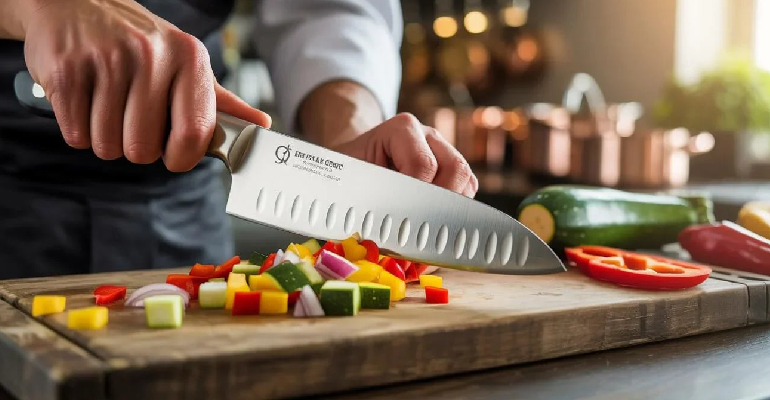
The knife category is where kitchen marketing does the most creative work. Sets of sixteen knives in a wooden block that include a bread knife, a carving knife, a boning knife, four steak knives, a santoku, two paring knives, and eight other things you will use twice and then forget — sold at a price that sounds significant but buys you sixteen mediocre knives rather than two or three excellent ones.
Professional kitchens don’t have sixteen-piece knife sets sitting in wooden blocks. They have the specific knives that do specific jobs well, maintained properly, used constantly. The way professional kitchens approach knives is the model worth following for home kitchens.
Three knives cover 95% of what any home cook needs to do:
A chef’s knife (8-inch for most people, 10-inch for people with large hands or who cook large volumes). This is the knife you reach for first for almost everything — chopping vegetables, breaking down chicken, slicing protein, mincing herbs.
A paring knife (3.5-4 inch). Peeling, trimming, precise detail work where a chef’s knife is too large. Tasks where you hold the food in your hand rather than working on a cutting board.
A serrated bread knife (10-inch). Bread, tomatoes, anything with a crust or skin that would compress under a straight blade.
That’s it. A honing rod to realign the edge between sharpenings and a whetstone or professional sharpening service when actual sharpening is needed. Five things. Not sixteen.
The Mac Professional MTH-80 costs around $150 and is the knife I recommend most often and most confidently to home cooks. The steel is harder than German knives (HRC 60-61 versus the 56-58 of most Wüsthof and Henckels knives), which means it holds its edge longer between sharpenings. The weight and balance is lighter than German knives, which some people find immediately intuitive and others find takes a week to adjust to. The dimples on the blade — which prevent food from sticking during slicing — are a functional feature rather than a decorative one.
The Wüsthof Classic 8-inch Chef’s Knife costs around $160-180 and is the German chef’s knife reference standard. It’s heavier than the Mac, with a different geometry — more curved at the tip for rocking motions, flatter at the heel for push cuts — and the weight is something many people find reassuring rather than burdensome. The steel is softer than the Mac, which means it’s slightly less prone to chipping on impact (important if your cutting style involves pushing through bones or frozen food) but requires more frequent honing.
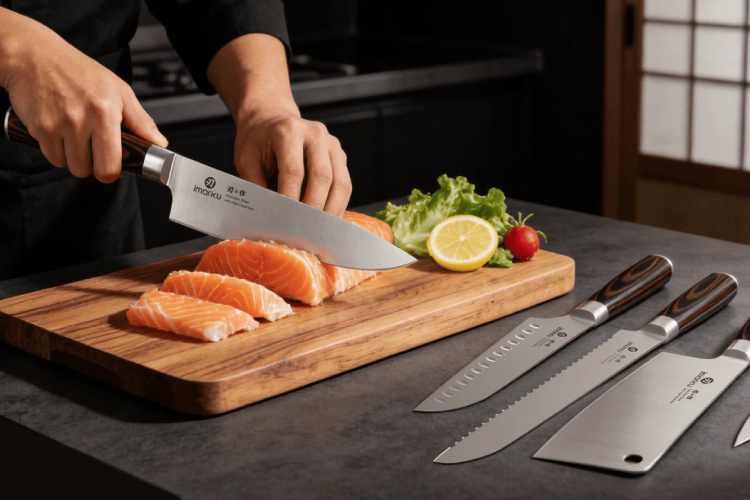
The Victorinox Fibrox Pro 8-inch costs around $40 and is the honest budget recommendation. It’s what professional cooking schools start students on. The stamped blade (cut from sheet steel rather than forged) has less rigidity and balance than forged knives, but the performance for regular home cooking is genuinely adequate and the price makes it accessible in a way the Mac and Wüsthof aren’t.
Japanese knives — Global, Shun, Miyabi — deserve mention because they’re significantly cheaper to enter than the reputation suggests. The Global G-2 8-inch chef’s knife costs around $100-120 and the steel (Cromova 18 stainless at HRC 56-58) and edge geometry produce an elegant, precise knife that’s particularly suited to the slicing and chopping style where the blade stays relatively straight rather than rocking. The all-steel construction is either the appeal or the concern depending on your hand — some people find the texture comfortable, others find it cold and slippery.
Most people with dull knives have knives that are not actually dull — they have knives with misaligned edges. When a knife is used, the microscopic edge of the blade folds slightly out of alignment. A honing rod realigns this edge without removing metal. Sharpening removes metal to create a new edge and is necessary much less frequently.
Running a knife along a honing rod (six to eight passes per side at a 15-20 degree angle for Japanese knives, 20-25 degrees for German) before each use keeps the edge performing at its best between sharpenings. A knife that seems dull but hasn’t been honed will often feel sharp again immediately after honing.
The best honing rod for most people: the Wüsthof 10-inch Honing Steel around $50 for German knives. The Idahone Fine Ceramic Sharpening Rod around $45 for Japanese knives — the ceramic is gentler than steel on harder Japanese steel and removes slightly more material to compensate for honing irregularities.
Sharpening — actual sharpening, not honing — should happen when honing no longer restores the edge. A whetstone (the King 1000/6000 grit combination stone for around $30 is the starting point for learning to sharpen at home) or a professional sharpening service (most kitchen stores offer this, typically $5-10 per knife) are the two options. Electric sharpeners tend to remove more metal than necessary and can change the blade geometry over time — they’re the low-skill option that produces acceptable but not excellent results.
A boning knife, unless you regularly break down whole chickens or large cuts of meat. The chef’s knife handles most butchery tasks with slightly less elegance and perfectly adequate results.
A santoku alongside a chef’s knife. They do overlapping tasks. Choose one.
Steak knives in a matching set. Individual steak knives from a good brand (the Laguiole en Aubrac steak knives are the reference standard; the Opinel folding steak knives are the value option) serve better than the matched set of steak knives that comes in a wooden knife block.
Any knife with a plastic handle decorated to look like wood. The manufacturing decisions visible at the handle extend to the blade. Knives that take shortcuts on visible elements almost always take shortcuts on invisible ones.
The cutting board a knife is used on affects how quickly the edge dulls more than most people realize. Glass and ceramic cutting boards are the worst possible surface — hard enough to roll the edge of a knife with every cut, completely unnecessary for any functional reason, and genuinely damaging to good knives. Never use a glass cutting board with a knife you care about.
Plastic cutting boards are fine for most purposes and have the advantage of being dishwasher safe for raw meat boards. They’re harder on edges than wood over extended use but not dramatically so with plastic that has some give.
Wood cutting boards — end-grain specifically — are the best surface for knives because the wood fibers part and close around the blade rather than rolling the edge the way cross-grain and harder surfaces do. The Boos end-grain boards are the reference standard at around $100-200 depending on size. IKEA’s Aptitlig bamboo board at $15 is the best argument for spending very little money on a cutting surface — bamboo is hard enough to be durable and gentle enough not to damage edges significantly.