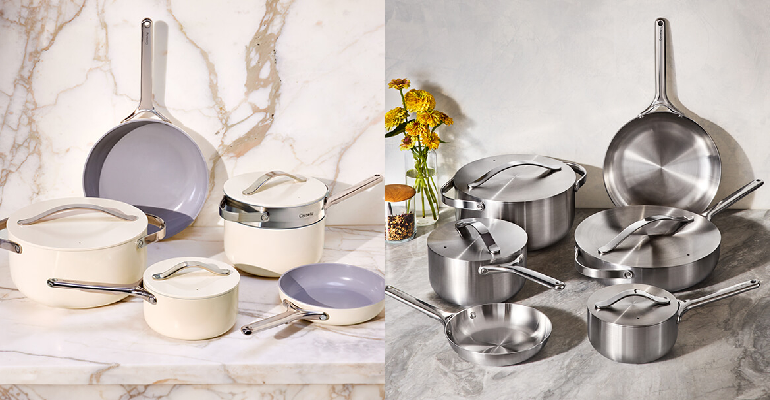
These two brands do not make equivalent products. This is the most important thing to establish before comparing them, because Caraway and Le Creuset are frequently placed in the same “premium cookware worth buying” category when they actually represent fundamentally different cooking philosophies, materials, and use cases. Understanding the actual difference determines whether a comparison is meaningful and which one belongs in a specific kitchen.
Caraway produces ceramic nonstick cookware — PTFE-free, beautifully designed, optimised for low-to-medium heat cooking, and sold with the storage system that distinguishes the brand aesthetically as much as functionally.
Le Creuset produces enamel-coated cast iron — the braisers, Dutch ovens, and skillets that are among the oldest and most thoroughly validated cookware constructions in existence. Cast iron heats slowly and retains heat for extended periods. The enamel coating eliminates the seasoning requirement of bare cast iron and provides a non-reactive surface for acidic foods.
These are different tools for different cooking. Comparing them directly is less useful than understanding which cooking activities each serves and how both might serve a complete kitchen.
Caraway for: Eggs, fish, pancakes, anything delicate requiring easy release. Sautéed vegetables at medium heat. Sauces that benefit from a nonstick surface. Everyday weeknight cooking at low to medium heat. Visual kitchen aesthetics — the Caraway set is genuinely beautiful.
Le Creuset for: Braises, stews, soups, anything benefiting from even heat retention over extended cooking time. Bread baking. High-acid dishes (tomato sauces, wine braises) that bare cast iron would affect. Oven-to-table cooking where the Dutch oven is both cooking vessel and serving piece. Cooking that requires high heat — Le Creuset handles temperatures that would damage Caraway’s ceramic coating.
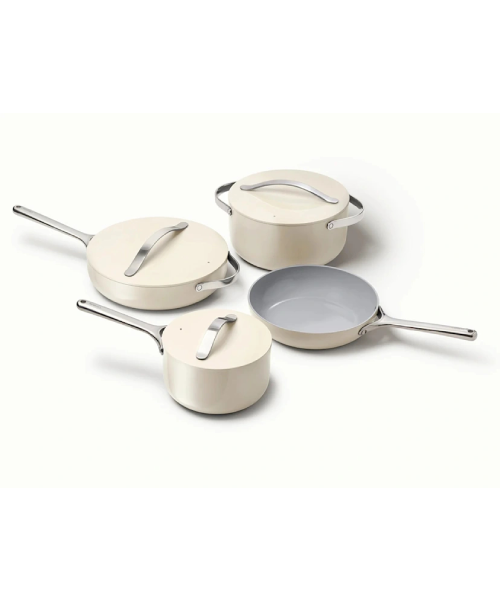
The Caraway set (4.5qt sauce pan, 3qt saucepan, 10.5″ frying pan, and 6.5qt Dutch oven) with included storage covers the core cooking situations for most weeknight household cooking. The ceramic coating quality is genuine — Year One performance is exceptional. The care requirements (medium heat maximum, no aerosol cooking spray, handwash) are specific and consequential.
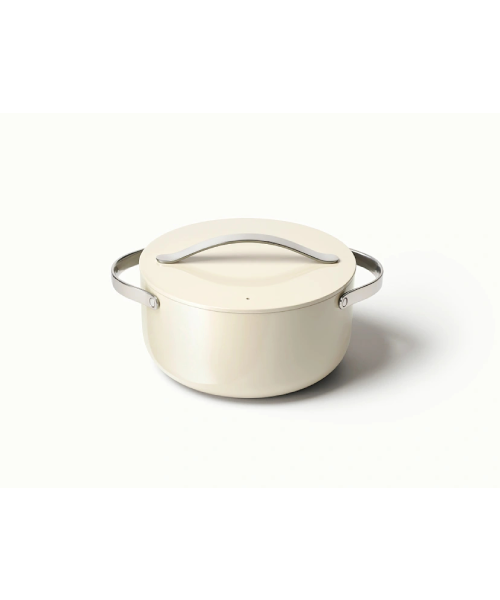
The Caraway Dutch oven is the single-piece recommendation for those who want to try the brand before committing to the full set. The ceramic enamel-like appearance suits kitchen display and the cooking performance for soups and sauces at appropriate temperatures is genuinely excellent.
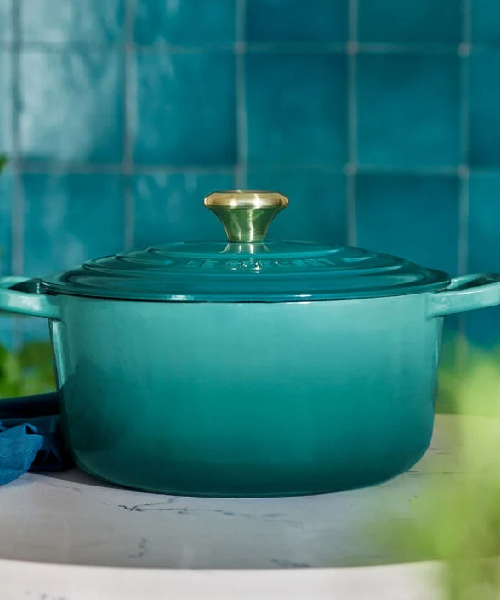
The Le Creuset French Oven (Dutch oven) in 26cm/5.5qt is the most versatile single piece in the brand’s range. The size suits dishes for four to six people — the beef bourguignon, the coq au vin, the sourdough loaf, the lamb shoulder — that benefit from the specific heat retention of cast iron.
The enamel quality that distinguishes Le Creuset from cheaper enamel cast iron is the specific advantage that the price reflects over a fifteen-year ownership period. The enamel does not chip under normal use. The cooking surface does not stain permanently. The colour maintains its richness. These are not qualities that cheaper enamel alternatives provide with the same consistency.
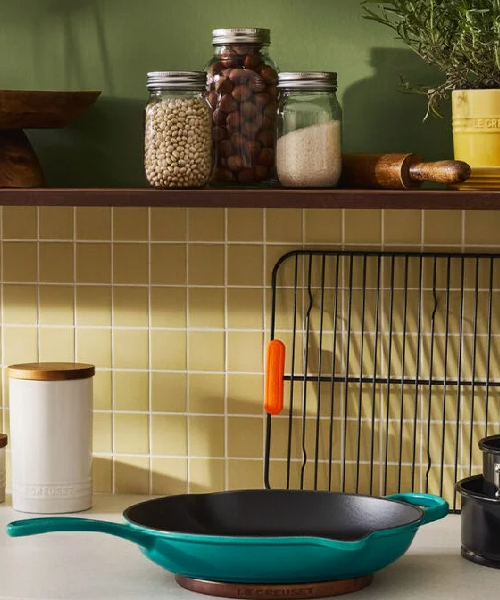
The Le Creuset skillet provides the high-heat searing capability that Caraway’s ceramic coating cannot safely handle. For proteins requiring a proper Maillard crust — steak, pork chops, chicken thighs — the cast iron skillet’s ability to sustain extreme heat makes it the correct tool. The enamel provides easier cleaning than bare cast iron while maintaining the heat properties.
Caraway’s ceramic coating: finite lifespan, well-maintained for 2–3 years of appropriate use, declining noticeably by year 3–4. The ceramic is a coating that degrades.
Le Creuset’s enamel cast iron: the enamel is fired glass, not a coating in the conventional sense. With appropriate care (no extreme thermal shock, no metal utensils on the enamel), Le Creuset’s enamel maintains its properties indefinitely. The cast iron beneath it lasts forever by definition. Le Creuset’s lifetime warranty reflects genuine confidence in the construction longevity.
Caraway 4-piece set at $395, potentially needing replacement in 5–7 years of regular daily use: $56–$79 per year.
Le Creuset French Oven at $400, lasting 20+ years: $20 per year.
The Le Creuset is the better long-term financial decision for the piece that will be used multiple times weekly for decades. The Caraway is the better decision for the everyday nonstick use cases that Le Creuset cannot serve.
These two brands belong in the same kitchen serving different functions — not competing for the same role.
The kitchen that has Caraway for everyday nonstick cooking and a Le Creuset Dutch oven for braises and soups is better equipped than the kitchen that has either exclusively. If forced to choose one:
For everyday weeknight cooking: Caraway’s complete set covers the majority of daily cooking.
For the investment piece that serves specific cooking situations for decades: Le Creuset French Oven.