Reformation vs Mango: Which Fashion Brand Wins?

The comparison between Reformation and Mango is not intuitively obvious — one is a premium DTC sustainable fashion brand, the other a mainstream European high-street retailer with a sustainability line. But both serve the same buyer profile in practice: the woman who wants feminine, contemporary women’s clothing with sustainability as either a primary or secondary consideration, in pieces that photograph well and wear reasonably well. That overlap makes the comparison worth making honestly.
The Brands
Reformation launched in Los Angeles in 2009 and positioned itself as the brand that made sustainable fashion aspirational rather than earnest. The RefScale that publishes carbon, water, and waste data per garment is the most detailed garment-level sustainability reporting in the accessible fashion market. The aesthetic — flowy satin dresses, cut-out details, specific linen pieces — has been influential enough that several seasons of Reformation design choices can be tracked directly in the wider market’s output.
Mango was founded in Barcelona in 1984 and operates in the Zara tier of European fashion retail. The Mango Committed line — their sustainability-positioned collection — uses more sustainable materials and processes than the main range. The sustainability credentials are secondary to the commercial positioning as a broad-appeal European women’s fashion brand with a strong contemporary aesthetic at accessible prices.
Quality Comparison
The quality gap between Reformation and Mango is real and meaningful for the long-term wear question. The honest comparison requires separating two things: how the garment presents on arrival and how it performs across a year of regular wear.
On arrival, a Reformation midi dress and a comparable Mango dress can look remarkably similar in terms of overall presentation. The fabric weight, the print quality, the construction finish — all are above fast fashion for both brands at their respective price points.
After six months of regular wearing and washing: Reformation holds up noticeably better. The TENCEL and deadstock fabrics used in much of the Reformation range maintain their drape and colour more consistently than the polyester-heavy composition that appears more often in Mango’s main collection. The Reformation seam construction is more robust.
This durability gap is meaningful for the price comparison. A Reformation dress at $228 that’s worn weekly for two years produces a lower cost-per-wear than a Mango dress at $79 that’s replaced after a season.
The Products

- Available at: Reformation (thereformation.com), in Reformation stores
- Best for: Those who want the signature Reformation slip dress silhouette in TENCEL or satin with documented sustainability credentials
The Cleo Mini is the most consistently worn Reformation piece in editorial context. The slip silhouette, the specific drape of the TENCEL fabric, and the range of colourways from neutral to statement produce a dress that reads as both casual and dressed-up depending on styling.

- Available at: Reformation (thereformation.com)
- Best for: Investment-quality linen suiting that works across seasons and dressing contexts
Reformation’s linen pieces are the category where the brand’s quality investment is most apparent. The linen blazer uses genuine linen that drapes and improves with washing in a way that the linen-look alternatives at Mango’s price point don’t replicate.
- Available at: Mango (shop.mango.com), in Mango stores
- Best for: Those who want the Reformation aesthetic direction at a significantly lower price point, with appropriate durability expectations
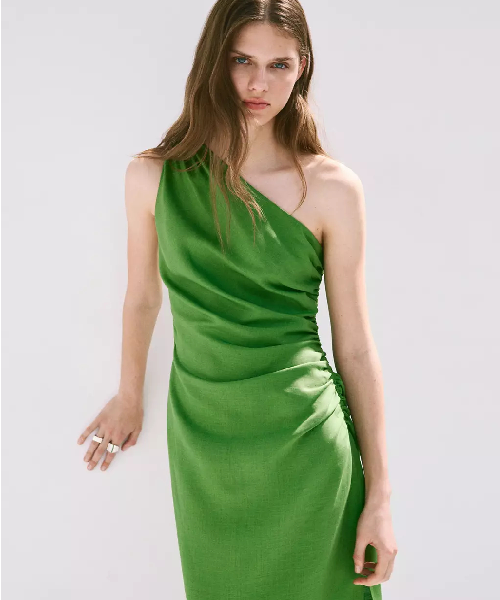
Mango’s fluid midi dress range consistently tracks Reformation’s silhouette direction at a fraction of the price. The comparison buyer — those who want the look without the investment — finds Mango’s equivalent at 35% of the Reformation price. The quality is proportionate to the price difference.

- Available at: Mango (shop.mango.com)
- Best for: Those who want linen suiting at a mid-range price with basic sustainability credentials
Mango Committed uses recycled and sustainably sourced materials in a line that provides a sustainability dimension without the full Reformation commitment. The linen blazer is the most compelling comparison piece for the Reformation equivalent — similar silhouette, meaningful price difference, real fabric quality difference that’s most apparent after multiple washes.
Sizing and Inclusivity
Reformation has expanded its size range but remains less comprehensive than Mango across plus sizes. Mango’s range extends further and with more consistent quality calibration across sizes. For buyers outside the standard Reformation size range, Mango provides better options in several categories.
The Sustainability Comparison
Reformation’s sustainability credentials are more rigorously documented than Mango Committed — the RefScale provides garment-level data that Mango doesn’t publish at the same granularity. However, Mango Committed’s use of recycled fibres and certified sustainable materials across a much higher volume of product means the absolute sustainability impact is not simply a function of which brand has better marketing. Both are better than the mainstream fast fashion baseline. Neither is the finished article in sustainable fashion terms.
The Verdict
For investment pieces intended for sustained regular wear: Reformation — the durability and material quality justify the price differential over the long wear calculation.
For the Reformation aesthetic at a lower price point as a starting point: Mango provides the most accurate approximation in the mainstream market.