HOME | Fashion | Beauty | Home Furnishing | Comparison | Top Reviews |

Pilates clothing has requirements that differ from general gym wear in specific ways that most people discover at their first class rather than before it. The leggings that were fine for spinning class slide on the reformer carriage. The crop top that’s acceptable in a general gym is too short for the leg circles and inversions in Pilates. The regular socks that work on every other gym floor are a genuine safety issue on a Pilates reformer.
Here is the specific guide for what to wear so you can focus on the class rather than on what you’re wearing.
The reformer requires leggings that stay in place during significant leg movement — leg circles, footwork, long stretch — and that don’t bunch, ride up, or slide. This means a high-waist construction that stays at the waist through inversions, a fabric that has some grip rather than being fully slippery, and a length that covers the knee because the knee resting on the carriage pad during certain exercises is more comfortable with coverage.
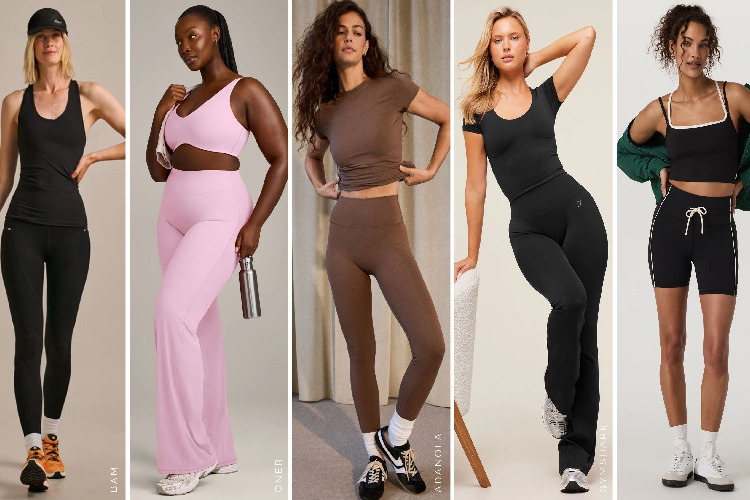
The Lululemon Align is the most-mentioned Pilates legging recommendation and the reasons are specific: the Nulu fabric grips slightly against the reformer surface rather than sliding, the waistband stays put through the full range of Pilates movement including inversions, and the fabric is breathable enough for the sustained but lower-intensity effort of Pilates. The seamless construction means no seam in the inner thigh to dig during the hip abduction work that Pilates involves.
The Girlfriend Collective Compressive legging is the accessible alternative — the compression fabric has enough surface texture to grip the reformer carriage without being the smooth, slippery surface that some fabrics produce.
What doesn’t work: very slippery fabrics that slide on the reformer. Very loose or baggy bottoms that catch on the springs and straps. Leggings with external seams on the inner thigh that create friction during leg work.
Pilates involves more inversion and leg-lifting movement than most gym classes. A regular cropped top that’s fine standing upright becomes too short during the teaser, the hundred, and any movement that brings the legs above hip height. The top that stays covering during a forward fold in yoga doesn’t stay covering during the full range of Pilates movement.
A close-fitting tank or long crop that stays tucked into or over the leggings throughout movement is the correct choice. The Lululemon Swiftly Tech Long Sleeve or any snug-fitting long-line tank stays in place through Pilates movement in a way that shorter crops don’t.
Loose tops also catch on reformer springs and straps during transitions. Close-fitting is both more practical and safer.
Grip socks are required at most reformer Pilates studios because bare feet on reformer footbar and carriage surfaces is a genuine slip risk and most studios have hygienic requirements that bare feet don’t meet. The grips on the sole of Pilates socks provide purchase on the footbar and carriage surface during footwork exercises.
The Tavi Noir grip socks are the studio staple — reliable grip, durable after multiple washes, and available in multiple lengths. The ToeSox full-toe grip socks are the alternative preferred by people who find the individual toe slots improve proprioception during balance and footwork exercises.
The grip socks sold at most Pilates studios are usually overpriced and lower quality than what you can buy directly. Buying a few pairs before starting a regular Pilates practice is more economical than buying one pair at the studio at each session.
Baggy clothing of any kind — it catches on springs and straps and makes the instructor’s job of observing your form harder. Zips or buttons on the back of clothing — they catch on the reformer carriage. Very long layers that drape beyond the body — same problem. Hard-soled shoes worn on the reformer — some studios allow trainers for standing work but generally closed footwear isn’t appropriate on the reformer carriage.