HOME | Fashion | Beauty | Home Furnishing | Comparison | Top Reviews |

I want to start with something nobody in the kitchen gadget review space ever says out loud. Most kitchen gadgets are not worth buying. The majority of products that get photographed beautifully, written about enthusiastically, and sent to your door in a box full of promises end up in one of three places: the back of a drawer, a charity shop bag, or the bin after the second time you used it and remembered why you stopped using it the first time.
I’ve been cooking every day for over a decade. Not professionally, not for content specifically, but because I eat food and I find cooking genuinely interesting in a way that has led me to spend more money on kitchen equipment than I’d like to admit. What that experience has produced is a reasonably clear picture of which tools earn permanent counter space, which ones earn drawer space, and which ones earn nothing at all.
This list is built entirely on things I’ve actually used, repeatedly, in real cooking situations. Not for a sponsored review, not for a first impression. For actual cooking.
I’m starting here because if you cook any kind of protein and you don’t have an instant-read thermometer, this is the single most impactful thing you can buy. Not a stand mixer. Not a fancy knife. A thermometer.
The Thermapen One from ThermoWorks reads temperature in one second. Not three to five seconds the way most cheap thermometers do — one second, accurate to ±0.5°F. The difference between knowing the internal temperature of a piece of chicken and guessing based on juice color and prayer is the difference between food you’re confident about and food you serve with low-level anxiety about whether you’re about to ruin someone’s evening.
It costs around $100, which sounds expensive for a thermometer until you’ve ruined a $40 piece of beef because you pulled it three degrees too early or four degrees too late. I’ve used mine almost daily for three years. The battery has been replaced once. The accuracy has not changed. This is the definition of a tool that earns its price.
The cheaper alternative worth knowing about: the Lavatools Javelin Pro Duo runs around $40 and performs at roughly 85-90% of the Thermapen’s level. For most home cooks this is entirely sufficient. The reading takes two to three seconds rather than one and the build quality is slightly less satisfying in the hand, but functionally it does the job.
Why this matters beyond just doneness: once you understand the target temperatures for different proteins — 165°F for chicken thighs, 130-135°F for medium-rare beef, 145°F for pork — and you can hit them consistently, you stop overcooking things out of anxiety. That one change improves the quality of your cooking across every meal that involves meat. It’s the highest ROI purchase on this list.
Most people are using a knife that is either cheap, dull, both, or the wrong size. The consequences of this are visible in how they cook: slow, imprecise, slightly dangerous (a dull knife requires more pressure, which means less control when it slips), and genuinely less enjoyable than it needs to be.
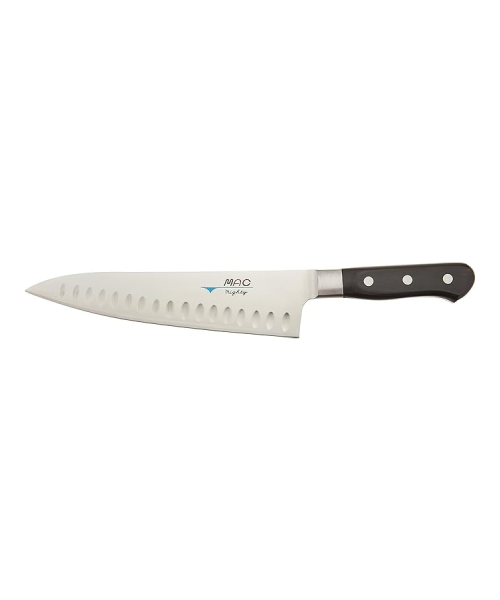
A good chef’s knife does not have to be expensive. The Mac Professional 8-inch costs around $150 and performs at a level that embarrasses knives at twice the price. It comes out of the box genuinely sharp — not department store sharp, which means slightly better than completely dull, but actually, noticeably, hair-shaving sharp. The steel is harder than most German knives (around 60-61 HRC versus the 56-58 of a typical Wüsthof), which means it holds its edge longer between sharpenings.
The weight and balance of the Mac Professional is lighter than German knives. This is either an advantage or something to get used to depending on what you’ve been using. For people coming from years of heavy German-style knives, the Mac takes a week or two to feel natural. For people new to quality knives, it feels immediately intuitive.
What the Mac won’t do: withstand poor treatment. Hard steel holds an edge longer but chips more easily if you put it in a dishwasher, store it loose in a drawer with other utensils, or use it on a glass or ceramic cutting board. A wooden or plastic board, hand washing, and a honing rod used regularly before each use is the maintenance protocol that keeps this knife performing for years.
The alternative worth considering: the Victorinox Fibrox Pro 8-inch costs around $40 and remains the recommendation for people who want a reliable, honest, good-enough kitchen knife without spending more. It’s what most professional cooking schools start students on. It’s not exciting but it performs well above its price.
The Dutch oven is the cooking vessel that does more things well than any other pot in a kitchen. Braises, soups, stews, chilis, no-knead bread, pasta sauces, frying, rice — the list of things a Dutch oven handles excellently is longer than the list for any other single pot.
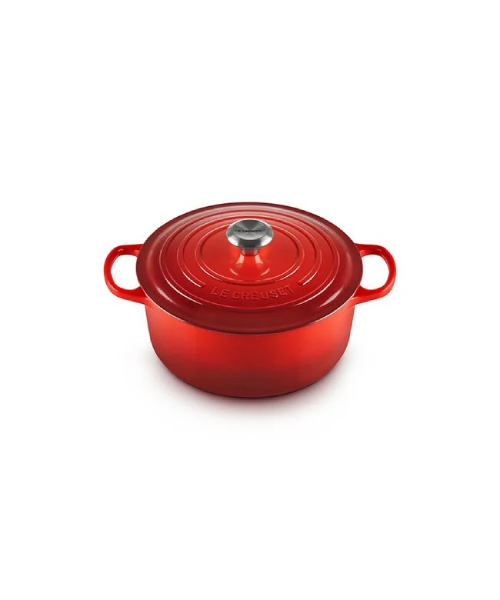
The Le Creuset Dutch oven is the aspirational version. Manufactured in France since 1925, the enamel coating is exceptional, the heat distribution is even and reliable, and the piece will outlast you if you treat it reasonably well. It comes in colors that look genuinely beautiful on a stovetop. It is expensive — a 5.5-quart runs $400-440 and goes on sale perhaps once or twice a year at meaningful discounts.
The Lodge Enameled Cast Iron Dutch oven is $60-80 and does 95% of what the Le Creuset does. The enamel interior is slightly rougher than Le Creuset’s polished surface, which means it has slightly more tendency to stick on lower-fat cooking. The exterior enamel chips more easily if knocked against other pots. But for braising, soups, bread baking, and the vast majority of Dutch oven applications, a home cook using a Lodge and a home cook using a Le Creuset are going to produce food that is indistinguishable.
The Staub is the third option that often gets overlooked. The matte black interior (sand-cast iron rather than smooth enamel) is better for browning than either Lodge or Le Creuset’s smooth enamel, and the lid design — textured bumps on the underside — baste food continuously with the condensation that collects during braising. It’s in the Le Creuset price tier and for braises specifically, many serious cooks prefer it.
My personal Dutch oven is a Lodge 6-quart that I’ve had for seven years. The enamel has one chip from the time I knocked it against the sink. It performs identically to when I bought it. I have cooked approximately one thousand meals in it. This is what good kitchen equipment looks like.
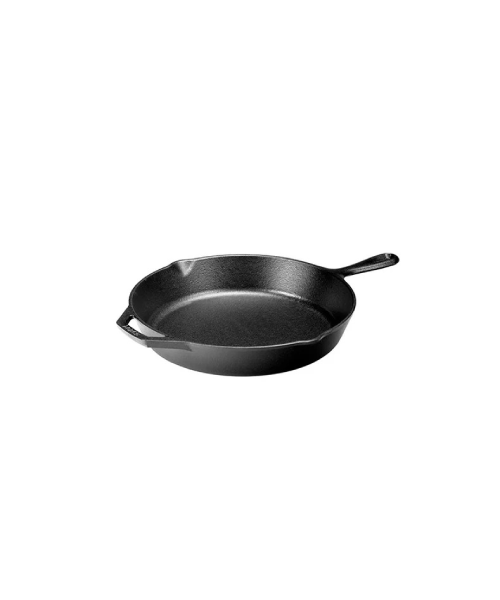
The Lodge 12-inch cast iron skillet is $40 at most retailers. It produces a better sear on a steak than pans that cost ten times as much. It goes from stovetop to oven to campfire without complaint. It makes cornbread that has a different character than cornbread made in anything else. It can be passed down to the next generation if you don’t do anything catastrophically wrong with it.
The maintenance reputation that puts people off cast iron is largely overstated. You dry it after washing (a few seconds on the stovetop solves this entirely), rub a thin layer of oil over the cooking surface, and store it. That’s it. It’s not complicated. It’s a ten-second process that keeps the seasoning in good condition indefinitely.
What cast iron is not good for: high-acid cooking (tomato sauces, wine-based dishes) in an unseasoned or lightly seasoned pan, where the acid can strip the seasoning and give the food a metallic taste. Well-seasoned cast iron handles this better but it’s not the ideal vessel for extended acid cooking. A stainless or enameled cast iron handles that better.
The carbon steel skillet is the restaurant industry’s version of the same idea. Lighter than cast iron, heats up faster, develops a similar nonstick surface with use, and is more suitable for high-acid cooking than bare cast iron. The Made In Carbon Steel and the Matfer Bourgeat are the two worth knowing about. Both require the same seasoning process as cast iron and both reward learning how to cook with them with a cooking surface that competes with any nonstick for eggs and any stainless for sears.
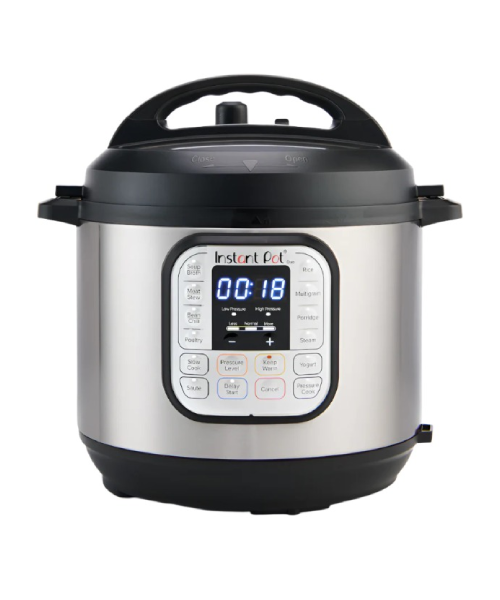
Pressure cookers halved the cooking time of a beef stew the first time I used one and I have not been able to unsee that fact since. The Instant Pot Duo 7-in-1 is the model that belongs in most kitchens — pressure cooker, slow cooker, rice cooker, steamer, sauté function, yogurt maker, and warming pot in one unit that takes up the space of a single pot on the counter.
Pressure cooking changes the economics of certain cooking projects. Dried chickpeas that would take eight hours of soaking and two hours of simmering take forty-five minutes from dry. A beef chuck roast that typically braises for three hours takes fifty minutes of pressure cooking and produces results that are comparable or better because the pressurized steam penetrates the meat differently than a standard braise. Stocks that normally simmer for four hours take ninety minutes.
The learning curve is real. The first few uses of a pressure cooker involve following the instructions carefully and possibly eating dinner thirty minutes later than planned because you miscalculated the come-to-pressure time. By the fourth or fifth use, the process becomes automatic and the appliance starts delivering on its actual promise: genuinely faster cooking of things that normally take a long time.
The sauté function is the feature that makes the Instant Pot more useful than a standalone electric pressure cooker. Being able to brown meat and aromatics in the same vessel you’re going to pressure cook in — without transferring between pots — matters for flavor development and for washing up.
Egg cookers. Scrambled eggs take four minutes in a pan. Poached eggs take three minutes in a pot of barely simmering water with a splash of vinegar. Hard-boiled eggs take eleven minutes in a pot of cold water brought to a boil. None of these require a dedicated appliance.
Spiralizers that aren’t the OXO Good Grips version. The cheap ones are dangerous (the blades flex, producing inconsistent cuts and occasional contact with fingers) and the expensive dedicated machines take up significant storage space for something you’ll use occasionally. The OXO handheld version does the job adequately without any of the storage problem.
Rice cookers, with one exception: if you eat rice every single day, a good rice cooker — Zojirushi or Cuckoo, not any of the $20 ones — produces genuinely better rice than stovetop with less attention required. If you eat rice two or three times a week, the stovetop method takes twelve minutes and produces excellent results with practice.
Most single-function appliances marketed as “space-saving” but which actually require their own dedicated cabinet space that you didn’t have before you bought them.
A bench scraper — $10-15, used by professional bakers and line cooks constantly, useful for transferring chopped vegetables to a pan, cleaning dough off a counter, portioning dough, and scraping a cutting board clean. It is one of the most useful kitchen tools that almost no home cook owns.
A spider strainer — the wide, shallow, woven basket on a long handle that Chinese cooking has used forever for lifting things from hot oil or boiling water. Better than a slotted spoon for pasta, better than tongs for fried items, better than a colander for anything you want to transfer in small batches. Around $10-15. Takes up minimal space. Used constantly once you have it.
A fish spatula — a flexible, slotted, thin-edged spatula designed for flipping fish fillets but genuinely useful for any delicate item. Pancakes, eggs, fish (obviously), anything that needs a spatula that doesn’t wedge forcefully under the food. The Wüsthof fish spatula is the one worth buying. It’s also one of the cheapest Wüsthof products at around $40.
Kitchen shears that come apart for cleaning. OXO makes a pair. They open along the blade for washing, which matters because the pivot point of shears that don’t come apart is impossible to clean properly and becomes a genuine hygiene concern with any regular use on raw meat or poultry.