HOME | Fashion | Beauty | Home Furnishing | Comparison | Top Reviews |

Hot sleeping is one of those problems that sounds minor until you’ve had it for long enough. Then it’s every night. Then it’s the thing you think about before bed, the reason you wake up at 2am, the reason you’re dragging yourself through the next day with a specific kind of tired that isn’t about hours slept but about quality. I knew all of this about myself before I started looking at bed cooling systems. What I didn’t know was how confusing the market would be, or how much money I’d spend finding out what actually worked.
I want to be upfront about something before this review gets going. Eight Sleep’s marketing is some of the best in the sleep industry. The Pod 4 looks extraordinary. The app interface is genuinely impressive. Their partnerships with professional sports teams and sleep scientists give the whole thing a credibility that’s hard to shake even when you’re trying to approach it objectively. I say this because I want to acknowledge that I went into testing the Pod 4 with a bias toward it being worth the money, and what I found complicated that bias in ways worth talking about honestly.
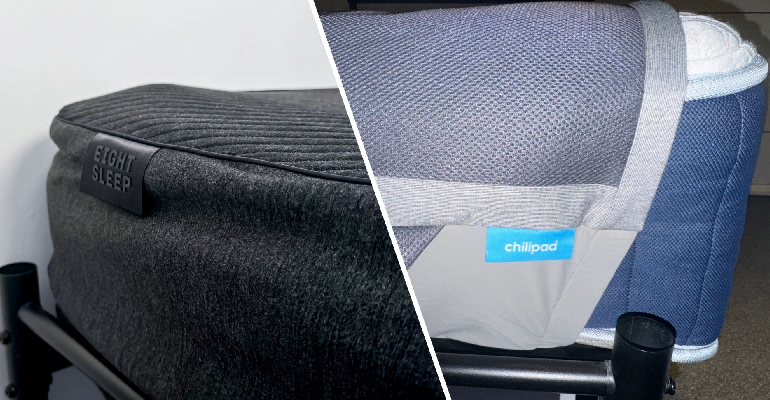
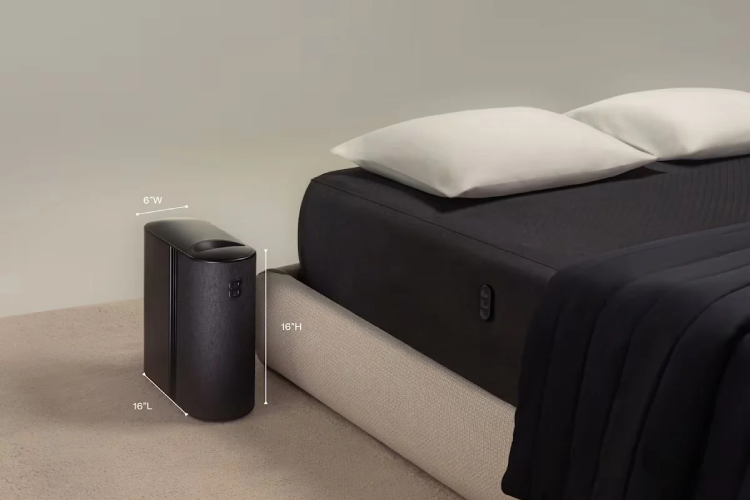
Eight Sleep makes what they call a smart mattress cover. The Pod 4 fits over your existing mattress like a very thick fitted sheet. Inside the cover is a network of water tubing. The tubing connects to a hub unit that sits beside your bed. That hub chills or warms water and circulates it through the tubing all night, keeping the sleep surface at whatever temperature you’ve set or whatever temperature the app’s AI decides you need based on your sleep stage data.
The system also tracks your sleep. Heart rate, breathing, movement, time in different sleep stages — all of this is monitored through sensors in the cover without you wearing anything. It integrates with the app to show you your sleep health data and, if you’re using the autopilot feature, automatically adjusts temperature throughout the night based on that data.
The subscription is not optional. You need it to use the autopilot and full tracking features. At $19-33 per month, you’re adding $228-396 to the annual cost of ownership on top of the $3,495 cover price. Over five years that’s somewhere between $1,140 and $1,980 in subscription fees on top of hardware you’ve already paid for in full.
ChiliPad’s Dock Pro does the core cooling job differently. There’s a pad that sits on your mattress under your fitted sheet, tubing connecting that pad to a dock unit on the floor, and the dock circulates temperature-controlled water through the pad. No AI. No automatic temperature adjustment. No sleep tracking. You set a temperature, it holds that temperature. Both single-zone and dual-zone options exist. The dual-zone option means you and your partner can each set different temperatures independently, which for couples with different temperature preferences is a serious practical feature.
The price for a dual-zone ChiliPad Dock Pro runs around $1,099-1,499 depending on configuration. No subscription required.
This is the number that matters most and I want to be precise about it. The Pod 4 can cool to 55°F. The ChiliPad Dock Pro can also cool to 55°F. At the low end of temperature range, both systems reach the same floor. This is important because the Eight Sleep marketing can create the impression that the Pod 4 achieves cooling that other systems can’t, and on the pure cooling performance metric, that impression isn’t accurate.
Where Eight Sleep genuinely leads is in how evenly that cooling is distributed across the sleep surface. The Pod 4 cover design routes water tubing in a way that gives more consistent temperature across the full mattress. The ChiliPad’s pad sits on top of the mattress and routes tubing through a pad, and in testing, certain areas of the pad ran slightly cooler or warmer than others. Not dramatically. Not in a way that most people would notice consciously. But measurable.
The other real performance difference is response time. The Pod 4 adjusts temperature and responds to setting changes faster than the ChiliPad, partly because of the closer integration between the cover and the hub.
For most people sleeping at 65°F or below who want consistent cooling: both systems work. The Pod 4 works slightly better. Whether “slightly better” justifies the price difference is the actual question.
I want to spend real time here because I think this is the part of the Eight Sleep equation that gets handled too quickly in most reviews.
The mandatory subscription isn’t just an additional cost. It’s a structural decision about what you’re buying. When you pay $3,495 for the Pod 4 cover, you’re not buying a device that functions independently. You’re buying hardware that requires ongoing payment to use its main differentiating features. The AI autopilot that adjusts your temperature automatically throughout the night — which is arguably the reason to pay $3,495 rather than $1,499 — is subscription-gated. The detailed sleep health data that Eight Sleep’s marketing leads with is subscription-gated.
Without the subscription, you have a very expensive temperature-controlled mattress cover that you can set manually. Which is exactly what the ChiliPad does.
I’m not saying the subscription is fraudulent or that Eight Sleep is a bad company. The features the subscription unlocks are real and some people genuinely value them. What I’m saying is that the full cost of the Pod 4 over five years — hardware plus subscription — is somewhere between $4,635 and $5,475, and that number deserves to be the starting point of the price conversation, not the $3,495 hardware figure alone.
The ChiliPad over five years: $1,099-1,499 hardware plus essentially zero in subscription costs. Some cleaning supplies. Maybe a coolant treatment once a year.
Eight Sleep’s sleep tracking is genuinely good. The contactless sensor approach — no watch, no ring, no wearable — produces reasonably accurate data on sleep stages, heart rate, and breathing patterns. For someone who wants comprehensive sleep health monitoring integrated into their environment without wearing anything, the Pod 4 does this well.
The question worth asking is whether you need this level of tracking, and whether the Pod 4 is the right way to get it if you do. An Oura ring or a Whoop strap gives you sleep tracking data at $300-500 (Oura) or $30/month subscription (Whoop) — both of these are considerably less than the Pod 4 hardware cost, and both produce data comparable to or better than the Pod 4’s integrated tracking. If sleep tracking is the primary appeal of the Pod 4 for you, a ChiliPad plus an Oura ring is a meaningful comparison.
Both systems make noise. The ChiliPad Dock Pro’s compressor runs at around 32 decibels in its standard mode. This is roughly the level of a quiet library. For light sleepers it’s perceptible, particularly in the first few nights before your brain learns to tune it out. Most people adapt within a week.
The Pod 4 hub runs at a comparable noise level. Neither system is silent and anyone claiming otherwise is either a heavy sleeper or being generous. The noise profile is different — the ChiliPad has a slightly more mechanical sound, the Pod 4 runs a bit more smoothly — but both are audible in a quiet bedroom.
If noise is a genuine concern for you, test with your partner present. What one person finds ignorable another finds impossible to sleep through.
The Pod 4 setup takes around 22 minutes if you’re following Eight Sleep’s app instructions carefully. It’s not difficult but it requires attention. The cover is heavy and awkward to install alone — getting it aligned correctly on a mattress by yourself is manageable but two people makes it considerably easier. The app requires you to create an account and make a subscription decision before first use, which some people find irritating as a philosophical matter.
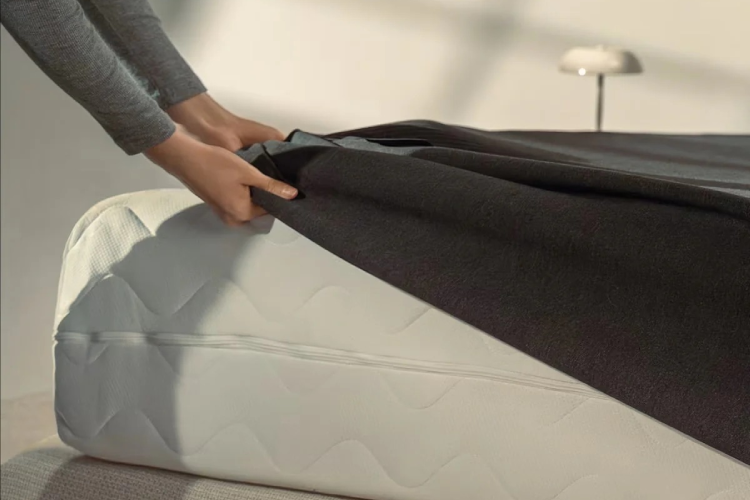
The ChiliPad setup is simpler. Pad goes on the mattress under the fitted sheet, hoses connect to the dock, dock gets water, app connects. The dock placement requires some thought because the hoses need to reach the pad and not be awkward. Once set up, the ChiliPad is genuinely low-maintenance — top up the water reservoir every 4-6 weeks, do an annual clean of the tubing.
I want to be specific here because “it depends” is not a useful answer.
Buy the Pod 4 if: you are a serious hot sleeper (waking multiple times per night drenched) who specifically values the AI autopilot temperature adjustment, you want integrated sleep tracking without wearing anything, you have a partner with significantly different temperature preferences (dual zone is included at no extra cost in Pod 4), and you are genuinely comfortable with the full five-year cost as calculated above — hardware plus subscription.
Buy the ChiliPad Dock Pro if: you want effective bed cooling at a fraction of the cost, you don’t need or want AI temperature adjustment, you’d rather set your temperature and have the system hold it, and you’re comfortable with a slightly simpler setup that requires a bit more manual management.
The Pod 4 is not a bad product. It is an excellent product at a price that requires a specific kind of buyer to justify. The ChiliPad is not a compromise product. It cools to the same temperature and does its core job reliably at a price that makes far more financial sense for most people.